
Going Drifting: Part 4 — Shift-Lock and Inertia Drifting
By Justin Banner
DISCLAIMER: Drifting, as with any motorsport, is dangerous and the techniques in these articles are to be done on a closed course. DO NOT DRIFT ON THE STREET!
You road racers will recognize this one as it’s something you’re trained to avoid as you learn heel-toe shifting in road race or autocross school. The “shift-lock” is actually wheel-hopping on purpose and you’ll start to downshift as you go into the corner. Now, instead of rev-matching, before going into gear you’ll keep your foot on the brake and let the clutch go. This will dramatically slow the rear wheels down and they will hop. Once you feel the hopping, get off the brakes and feed some throttle in to keep the drift around the corner.
This can be a difficult technique to learn and do correctly on the first try. Not only could you hold the brake too long and over-rotate, but also you could stall the car. The moment you feel the rear bounce and the rear start to rotate around, get off the brake and get on the gas.
Inertia Drifting
This is a technique that can be a bit hairy to do the first time and is usually a more advanced technique. Instead of locking up the rear tires as done previously, we’re going to use the inertia and weight shifting that the car has to get drifting. Again, this isn’t necessarily a technique for the first-timer or even the faint-hearted as you’ll be carrying a lot of speed into the corner. However, as you drift and learn what the car actually does as you slide, you’ll realize you scrub a lot more speed than you would expect.
The idea for initiation is to carry speed into the corner, and at the last second let off the throttle all at once. This will cause all of the weight to go from the rear of the car to the front quickly. The rear of the car then becomes light and drifts around. Sometimes adding a dab of brake will help this weight shift. Another way to do this with not as much speed is a pendulum drift where you’ll start on the racing line and then suddenly steer the car to the opposite side of the track and then back to the racing line. This will shift the weight to the other side of the car to start a drift. This pendulum motion is done quickly to shift the weight around fast enough to initiate a drift.
Chime in with your thoughts on the forum. >>
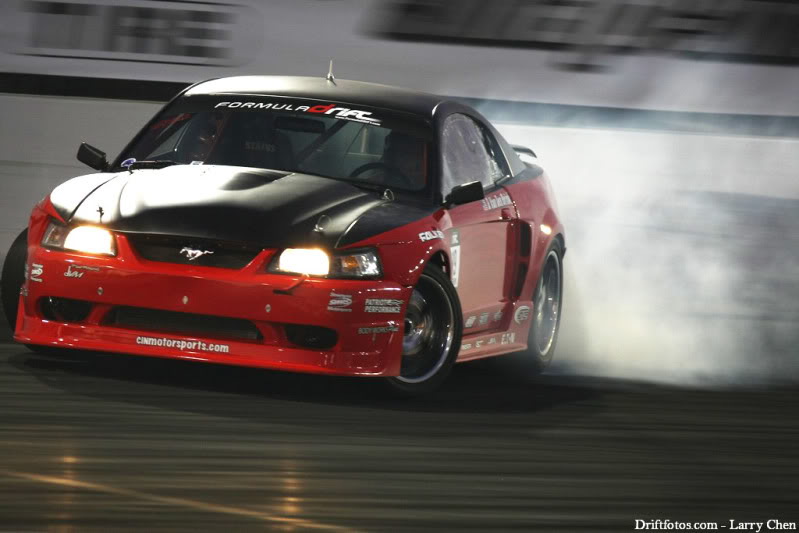
image [DriftFotos.com – Larry Chen]
You must be logged in to post a comment.