


IFR Question

5th Gear Member
Joined: Sep 2005
Posts: 2,505
From: Wasilla, Alaska

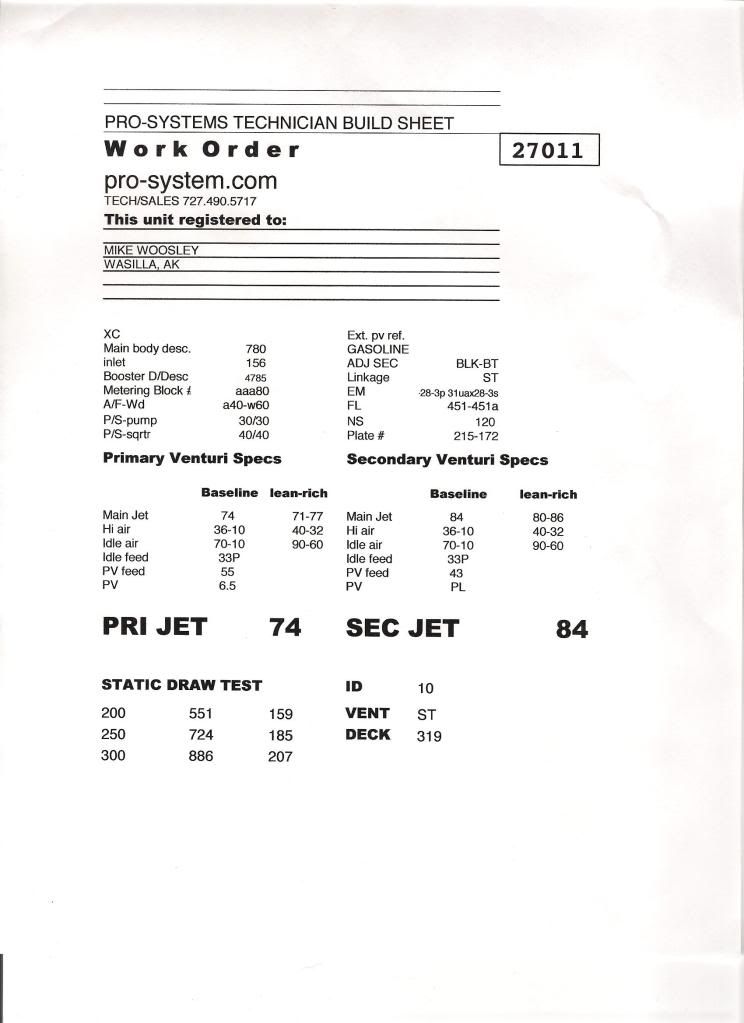
I've been following this thread now for a while. I just installed my ProSystems carb last week. I've been increasing my idle air bleeds since I cannot get the required minimum 1 1/2 turns out on the idle mixture screws. Bumping up my timing and going back to my larger blower pulley helped somewhat. At .070 I was at 1/2 turn out with 14ish readings at idle. I then went from .070 to .073 to .076 and can only get 3/4 turn out keeping my 14.6 reading at idle. I need to purchase more bits tomorrow before I can continue. I am heading in the right direction. Patrick recommends going .010 increases. My WOT is in the 13's. I'll be lucky if I can get by with just increasing my idle air bleeds. I am going about this kind of backwards. I have purchased a new Aeromotive fuel system and should install that before tweaking the 02. I just couldn't wait since that nice new shiny carb was just sitting there before all my AN fittings arrived. Attached are my carb specs and a great e-mail Patrick sent me for tuning the carb. I can honestly say, ProSystems has great customer service. I have emailed Patrick at least 4 times and he is very prompt with his replies.

Last edited by valley firearms; Jul 12, 2010 at 12:06 AM.

Thread Starter
5th Gear Member
Joined: Apr 2007
Posts: 2,100
From: Texas Hill Country
Valley, thanks for that. Yeh, Patrick has been pretty good. I have been a little frustrated trying to get this cruise issue lined out as nothing has really affected it, but he always responds the same day that I send him an email.
I drilled the metering block the weekend. I actually did a stupid rookie thing and got the metering block upside down and turned around so that I ended up drilling out the lower emulsion ports instead of the top. Man I felt dumb. I ended up drilling out the top ports and going on a 50 mile test drive. I saw no real change in the cruise throttle AFR. Honestly, I did not see much change in the fuel curve at all. I expected to see a leaner top end since I screw up the drill, but did not see much of anything.
I am considering drilling out my idle air bleeds past the 100 (.128)...maybe (.150 or so) just to see if I can get it to lean out. My idle screws are out about 2.25 turns as it sits right now. I think the rich condition is coming from the transfer slot, but I cannot prove it.
I drilled the metering block the weekend. I actually did a stupid rookie thing and got the metering block upside down and turned around so that I ended up drilling out the lower emulsion ports instead of the top. Man I felt dumb. I ended up drilling out the top ports and going on a 50 mile test drive. I saw no real change in the cruise throttle AFR. Honestly, I did not see much change in the fuel curve at all. I expected to see a leaner top end since I screw up the drill, but did not see much of anything.
I am considering drilling out my idle air bleeds past the 100 (.128)...maybe (.150 or so) just to see if I can get it to lean out. My idle screws are out about 2.25 turns as it sits right now. I think the rich condition is coming from the transfer slot, but I cannot prove it.
Thread Starter
5th Gear Member
Joined: Apr 2007
Posts: 2,100
From: Texas Hill Country
I just sent an email to Patrick. I wish Pro Systems offered a billet fully adjustable metering block like Quick Fuel has so that stupid tweakers like me could fine tune without screwing things up. I like the undo option of the screw in ports.
Thread Starter
5th Gear Member
Joined: Apr 2007
Posts: 2,100
From: Texas Hill Country
I asked Patrick if I totally screwed up my metering block with my block head drilling of the lower instead of up emulsion port. He said, "The lower won't really come into play much beyond the 028 as the uppers have already used up anything over that...". I guess I still do not really understand emulsion ports. I thought the lower ports controlled the fuel curve at higher rpms...guess its voodoo tuning these things.
He suggested down sizing the primary jets 4 sizes and seeing what that does to the cruise AFR. If that bring it down, we are then going to increase the Power Valve Feed Restrictors as my motor drops below 8-9" with any real acceleration and I am running a 8" PV. This makes since to me.
He suggested down sizing the primary jets 4 sizes and seeing what that does to the cruise AFR. If that bring it down, we are then going to increase the Power Valve Feed Restrictors as my motor drops below 8-9" with any real acceleration and I am running a 8" PV. This makes since to me.

6th Gear Member
Joined: Apr 2007
Posts: 10,468
From: California
If the upper emulsion ports max out the airflow capacity of the high speed bleed, then the lower emulsion will have little effect. By the time fuel level gets there you're not getting any more air through the emulsion/air bleed.
Thread Starter
5th Gear Member
Joined: Apr 2007
Posts: 2,100
From: Texas Hill Country
Oooooohhhhh. I guess that makes sense. I wonder why some of these high end metering blocks have 5 emulsion tubes if typically you only feed it 28-40 on the HSAB? Looks like to me, you would rarely need more than 2-3 as all your air would be "used up" before you get to the 4th port. The 5 emulsion blocks use 28s in the first three and 20s in the bottom two. Based on this, I do not see that the lower ports get any love.
Patrick had be jet down 4 jets to see what the cruise AFR did. It came up to mid 13s, but as I opened the throttle more, the AFR got lean, as you would expect. I am not to enlarge the PVCRs or PVFR what every you want to call them until my low vacuum primary only AFR is back in the 13s. This will probably mean increasing from .055 to .060 or so.
I recently read an chapter in one of my Holley carburetor books that says something like you can tune for economy or performance but rarely both. They also said that this was basically not important on drag cars, but fairly important on road race cars as they vary throttle position all the time. They suggest a compromise as jetting down the primary to get some economy and then tuning the power valve and PVCRs to compensate for the lack of fuel when the demand is there. They did not go into detail, and I passed over it a dozen times as I have reread the book. I guess this is what they were talking about.
Patrick had be jet down 4 jets to see what the cruise AFR did. It came up to mid 13s, but as I opened the throttle more, the AFR got lean, as you would expect. I am not to enlarge the PVCRs or PVFR what every you want to call them until my low vacuum primary only AFR is back in the 13s. This will probably mean increasing from .055 to .060 or so.
I recently read an chapter in one of my Holley carburetor books that says something like you can tune for economy or performance but rarely both. They also said that this was basically not important on drag cars, but fairly important on road race cars as they vary throttle position all the time. They suggest a compromise as jetting down the primary to get some economy and then tuning the power valve and PVCRs to compensate for the lack of fuel when the demand is there. They did not go into detail, and I passed over it a dozen times as I have reread the book. I guess this is what they were talking about.
Last edited by urban_cowboy; Jul 13, 2010 at 08:28 AM.

6th Gear Member
Joined: Oct 2006
Posts: 6,417
From: Cork, Ireland
A few opinions on this
a) any chance your PV is adding fuel to the mixture during cruise? what is manifold vacuum in yours at a steady 50/60/70mph cruise. what is it at idle? I have a feeling the 8" PV might neeed to be lowered
b) I like the article attached to valleys post (welcome back by the way. haven't heard of you a while). I kinda like the idea with "opening the idle mixture screws and keep adding air to it until you have it idling with them being 1.5 turns out". I have them one turn out which seems rich (stink), but any less will hesitate/stall. Makes sense to me and the demon has that nice feature for adding the air (4 corner), but I just never knew how to use it properly. I'll try that tonight or tomorrow for the craic of it
However neutral rpm of 1200 with timing at 22 sounds a bit mad ?!
67m302: good point with the HSAB being "used up to capacity". good point, would have never thought of that
a) any chance your PV is adding fuel to the mixture during cruise? what is manifold vacuum in yours at a steady 50/60/70mph cruise. what is it at idle? I have a feeling the 8" PV might neeed to be lowered
b) I like the article attached to valleys post (welcome back by the way. haven't heard of you a while). I kinda like the idea with "opening the idle mixture screws and keep adding air to it until you have it idling with them being 1.5 turns out". I have them one turn out which seems rich (stink), but any less will hesitate/stall. Makes sense to me and the demon has that nice feature for adding the air (4 corner), but I just never knew how to use it properly. I'll try that tonight or tomorrow for the craic of it
However neutral rpm of 1200 with timing at 22 sounds a bit mad ?!
67m302: good point with the HSAB being "used up to capacity". good point, would have never thought of that
Thread Starter
5th Gear Member
Joined: Apr 2007
Posts: 2,100
From: Texas Hill Country
At idle, my engine runs 8-10" of vacuum depending on the air temp. Patrick said that the PV will add very little fuel if any during idle so do not worry about it "opening" during idle because of low vacuum. At cruise, with normal AFR levels, my engine runs about 16-18" vacuum. This drops to about 7-10" with some load and will drop to 0-5 depending on the amount of throttle I give it. These numbers are while driving 60-80mph on the highway in high gear (1:1) so the engine is having to work the most under these conditions. In 3rd gear at the same speed, the vacuum is higher and does not dip near as easy because the engine is not working very hard. I do not think there is any way the PV is opening during cruise throttle as you can see the AFR lean out with just a little more throttle. Before I started working on this again, it would go from 12:1 to 14:1 with just a little throttle change and stay there until I hit the secondaries. I was thinking originally that this was an idle/transfer slot circuit issue, but Patrick showed me that by jetting down the main jets, it affected the cruise AFR which was the only thing that really affected the cruise AFR. That pretty much pointed the finger at the main booster circuit and main jets. It is kinda like robbing Peter to pay Paul. I am taking away main jetting fuel but adding it back under the power valve circuit so that my overall booster fuel is the same under load, but under very light load it gets less fuel through the main jet circuit. I had hoped to just take care of it by modifying the fuel curve but the emulsion change did not really affect it. I think I would have had to make a big change in the top emulsion size to really affect it as you have to make big changes in the air to really affect the AFR because there is 13-14 times more air than fuel. This is just my guess...Patrick did not allude to that.
On a related note. I have read a few Internet articles saying that when going from a 3 emulsion block to a 4 or 5 emulsion block, you are still looking to keep the air flow via total hole area the same, just just divide it out over 4 or 5 ports instead of 3. You can then fine tune the air entry in smaller main well ranges. So if I understand that correctly, if you have a 3 emulsion block with 28s (what my carb had to begin with), that is .00186 square inches of total emulsion port. If you spread that out over 5 ports, you would run 21s or 22s in all five ports. You could then go up or down as needed on the various ports to fine tune the AFR for the given fuel level in the well. Does that sound right? The thing is, I see the AFR move around a lot even while just cruising down the road, so fine tuning would be really hard to do I would think.
On a related note. I have read a few Internet articles saying that when going from a 3 emulsion block to a 4 or 5 emulsion block, you are still looking to keep the air flow via total hole area the same, just just divide it out over 4 or 5 ports instead of 3. You can then fine tune the air entry in smaller main well ranges. So if I understand that correctly, if you have a 3 emulsion block with 28s (what my carb had to begin with), that is .00186 square inches of total emulsion port. If you spread that out over 5 ports, you would run 21s or 22s in all five ports. You could then go up or down as needed on the various ports to fine tune the AFR for the given fuel level in the well. Does that sound right? The thing is, I see the AFR move around a lot even while just cruising down the road, so fine tuning would be really hard to do I would think.
Last edited by urban_cowboy; Jul 13, 2010 at 11:51 AM.
6th Gear Member
Joined: Oct 2006
Posts: 6,417
From: Cork, Ireland
sounds right with the PV but wouldn't harm to just try with a 6.5" just to see if there's a difference. you say the A/F jumps around a lot during cruise, how much so? can you upload a graph? mine stays pretty stable once i don't move throttle and road doesn't change up/downhill. with the 4 jets down and the cruise being ok, what's the WOT A/F now? and did you change the front only or front+back?
Thread Starter
5th Gear Member
Joined: Apr 2007
Posts: 2,100
From: Texas Hill Country
I actually upped the jetting on the secondaries two jets because it was running mid 13s and I wanted to see high 12s. Since I jetted down the primary, I did not do a WOT pull because I have not adjusted the PVCRs yet so the front side would be running pretty lean under WOT. I acutally have never pulled data from my LM2. I only watch the left and right band read out as I drive down the road. Under normal conditions, I would say at idle, it will fluctuate .3-.5 and at constant cruise it will fluctuate .3-.8. I do not know if this is because I have true dual exhaust without a crossover pipe or what. I have an O2 in each pipe though, and they are within .2 of each other since I installed my new Dr. J's intake.With setup, the AFR from no throttle to 50% throttle varied from 13.2-16.5, but attribute that to needing more fuel from the PV circuit that it did not have.