


Floor Panels


Thread Starter
1st Gear Member
Joined: Aug 2010
Posts: 133
From: IL
 Floor Panels
So I finally got a welder and still have a bit of practice to do. I have a few holes in my rear floor boards that I need to patch up. None are even as large as a fist.
I'm not doing a concourse restoration and most likely will not do shows. I really just want a solid cruiser, maybe daily summer driver. I won't need to do any bending to match contours as nothing is in a corner or on a curve.
Should I get replacement rear panels and cut my patches from that, or, should I just get some sheet metal and use it to patch them? If your recommendation is to just get sheet metal, what gauge metal is the floor board?
I'm not doing a concourse restoration and most likely will not do shows. I really just want a solid cruiser, maybe daily summer driver. I won't need to do any bending to match contours as nothing is in a corner or on a curve.
Should I get replacement rear panels and cut my patches from that, or, should I just get some sheet metal and use it to patch them? If your recommendation is to just get sheet metal, what gauge metal is the floor board?

5th Gear Member
Joined: Aug 2007
Posts: 2,243
From: PA
Lets see pics of what you got going on.
Always remember that rust is almost always three times bigger then what you see to get to good solid metal, so keep that in mind.
18-20 gauge metal will be fine for floor work and maybe cheaper then buying panels and cutting them up.
You can also practice all you want and that is fine, but you will quickly find out it is a whole other learning curve when you actually start welding on the car, this is where you will learn the rust is usually 3 times bigger rule when you start to get blow through with what you thought was good metal especially in areas where you can't see behind what your patching.
You will also quickly learn it is different welding new to new metal, old to old, new to old, and old to new. No amount of practice will prepare you for this, only actually doing it on the car and adjusting things as you go to accommodate what is going on because the car has many more variables to it then any practice metal.
You may get the basics down, but the car is the real world and she can be a bitch when she wants to be.
If you got old body parts lying around, it may be a good idea to keep them and use them as patches as they can and may weld better then new to old metal. Another thing I learned along the way.
The best practice is doing work on the car and go from there. Start with the smallest hole and work up as your confidence grows.
Good luck and let's see pics of what you got going on.
Lynn
Always remember that rust is almost always three times bigger then what you see to get to good solid metal, so keep that in mind.
18-20 gauge metal will be fine for floor work and maybe cheaper then buying panels and cutting them up.
You can also practice all you want and that is fine, but you will quickly find out it is a whole other learning curve when you actually start welding on the car, this is where you will learn the rust is usually 3 times bigger rule when you start to get blow through with what you thought was good metal especially in areas where you can't see behind what your patching.
You will also quickly learn it is different welding new to new metal, old to old, new to old, and old to new. No amount of practice will prepare you for this, only actually doing it on the car and adjusting things as you go to accommodate what is going on because the car has many more variables to it then any practice metal.
You may get the basics down, but the car is the real world and she can be a bitch when she wants to be.
If you got old body parts lying around, it may be a good idea to keep them and use them as patches as they can and may weld better then new to old metal. Another thing I learned along the way.
The best practice is doing work on the car and go from there. Start with the smallest hole and work up as your confidence grows.
Good luck and let's see pics of what you got going on.
Lynn
Last edited by LynnBob Mustang; May 22, 2012 at 11:45 AM.


1st Gear Member
Joined: Jan 2012
Posts: 67
From: New Mexico
I'm in the same situation as the thread starter. I got the patch panels and did some practicing over the weekend. I was using a fender off of a new toyota to practice on and I kept getting blow through and couldn't figure out why. It's a lot more involved than it looks. My welds started looking better when I moved to thicker material so I am hoping that if I go with the 1/2 inch over lap I will not get blow through.
5th Gear Member
Joined: Aug 2007
Posts: 2,243
From: PA
I know I can buy that for less then $25 at my local hardware store. That would be more then enough to do what he seems to be asking about.
The panels at those prices are overkill and is money better spent else where.
Lynn

4th Gear Member
Joined: Oct 2005
Posts: 1,195
what welder did you get? Several of us can help you with your welding. Try this webpage.
http://www.weldingtipsandtricks.com/index.html Alot of good information. Overall original sheet metal is 18ga. Replacement sheetmetal is 18, or 20 ga. One thing you need to learn immediately when welding sheet metal is PATIENCE. Sheetmetal gets hot easily, and hot sheetmetal blows through even easier. I always have a blow gun or a cold rag nearby when welding sheetmetal.
http://www.weldingtipsandtricks.com/index.html Alot of good information. Overall original sheet metal is 18ga. Replacement sheetmetal is 18, or 20 ga. One thing you need to learn immediately when welding sheet metal is PATIENCE. Sheetmetal gets hot easily, and hot sheetmetal blows through even easier. I always have a blow gun or a cold rag nearby when welding sheetmetal.

4th Gear Member
Joined: Oct 2007
Posts: 1,751
From: Central Illinois
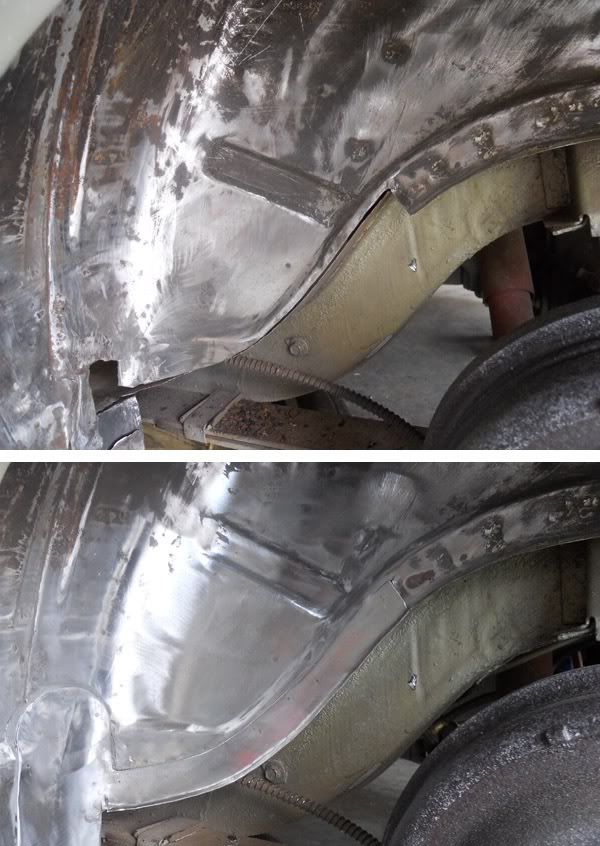
I didn't go the welding route. I used panel bond on my patches. Same stuff they glued my 2005 Mustang together with right from the factory. Also what the autobody shop would use to attach a replacement quarter at the door and the tail. This is a bonded patch inside the front of the right rear wheel well. Panel bond is expensive - about $40 for a caulk size tube - but it is unbelievably strong. I have some patches going on four years old and which have been subjected to temps from -20 to 110, plus road vibration.
Thread Starter
1st Gear Member
Joined: Aug 2010
Posts: 133
From: IL
I got a Hobart Handler 140 welder. Found it on sale at Tractor Supply. I can't afford gas right now so I have to take it slow with flux core wire, but it doesn't seem so bad from the practicing I've done. I don't mind grinding down the extra. I won't be doing that much welding on the car for it to really save me a lot of time to have MIG.
I have an added question. I forgot about the battery tray area. I have found the replacement fender side panel, but I don't see the front end side of that corner which is in really bad shape as well. Can anyone post a link or name with that piece would be? If I had pics I'd post them. I don't have the extra money to replace my camera right now.
I have an added question. I forgot about the battery tray area. I have found the replacement fender side panel, but I don't see the front end side of that corner which is in really bad shape as well. Can anyone post a link or name with that piece would be? If I had pics I'd post them. I don't have the extra money to replace my camera right now.
4th Gear Member
Joined: Oct 2005
Posts: 1,195
sounds like your refering to the radiator support.
You'll be happy with your hobart 140. To optimize its performance, make sure you use a good 20amp receptacle. Don't share it with anything while you're welding. Second, always make sure you have a good ground. Last, a small bottle of 25/75 is probably $100 which should include a full bottle and deposit. Harbor Frieight will usually have the regulator for another $25 or so. You can always upgrade to a larger bottle later. Shielding gas makes for a much better weld, and far less clean up. Enjoy! Remember, prep is 90% of the work. If you Hobart is like my Miller, it should do 3/16" plate easily.
You'll be happy with your hobart 140. To optimize its performance, make sure you use a good 20amp receptacle. Don't share it with anything while you're welding. Second, always make sure you have a good ground. Last, a small bottle of 25/75 is probably $100 which should include a full bottle and deposit. Harbor Frieight will usually have the regulator for another $25 or so. You can always upgrade to a larger bottle later. Shielding gas makes for a much better weld, and far less clean up. Enjoy! Remember, prep is 90% of the work. If you Hobart is like my Miller, it should do 3/16" plate easily.