


Quick Horsepower


1st Gear Member
Joined: Mar 2006
Posts: 56
From: Alabama

The formula for horsepower is : hp = (torque*rpm)/5252
plugging in 0 for torque yields : hp= (0*rpm)/5252= 0
So you are correct

The units for torque are ft-lb. The units for horsepower are ft-lb/min. (although hp is considered a unit in itself)
Basically, torque moves cars, hp is just a way to measure how quickly it is moved.



3rd Gear Member
Joined: Aug 2006
Posts: 886
From: North East Texas on the Red River
Although you are making conflicting statements, we are getting a better picture of what you're looking for.
Modifying an engine for more horsepower will very rarely provide better fuel economy. Typically horsepower is increased by moving the torque peak to a higher RPM. This is NOT conducive to better fuel economy. The world is a compromise. You usually can't have something without giving up something else. Todays engines have accomplished more power and better fuel economy, but they have done it with Millions of dollars in research leading to new engine designs, fuel injection et al.
When you indicated that you want more horsepower and better fuel economy, the story of the teenager wannabe musician came to mind. The teenager told his Dad "When I grow up I want to be a Rock Musician." His Dad said, "I'm sorry son, but you can't have it both ways."
If you're looking for fuel economy, your basic engine is very close to being optimized. Consider your heads already modified. Some people modify small Fords by using the very heads that you have on your engine as their head package upgrade.
There are two modifications that come to my mind that would offer more torque and better fuel economy. The most important improvement would be a set of small tube, full length exhaust headers and properly rejet the carburetor to take advantage of them. This would provide a significant torque increase throughout the entire RPM range.
The second thing would be an RV type cam. The cam in your 73 engine was ground in a crazy era when Detroit was scrambling to find their way to cleaner running engines. In the course of this effort, the 73 engines were some of the worst. They were killing power and fuel mileage in an effort to achieve less emmissions. A real good cam would be a Comp Cams High Energy or equivalent from other cam grinders. These are designed for low compression engines and will increase cylinder pressure and provide more torque with a fuel economy improvement.
My $0.02,
Modifying an engine for more horsepower will very rarely provide better fuel economy. Typically horsepower is increased by moving the torque peak to a higher RPM. This is NOT conducive to better fuel economy. The world is a compromise. You usually can't have something without giving up something else. Todays engines have accomplished more power and better fuel economy, but they have done it with Millions of dollars in research leading to new engine designs, fuel injection et al.
When you indicated that you want more horsepower and better fuel economy, the story of the teenager wannabe musician came to mind. The teenager told his Dad "When I grow up I want to be a Rock Musician." His Dad said, "I'm sorry son, but you can't have it both ways."
If you're looking for fuel economy, your basic engine is very close to being optimized. Consider your heads already modified. Some people modify small Fords by using the very heads that you have on your engine as their head package upgrade.
There are two modifications that come to my mind that would offer more torque and better fuel economy. The most important improvement would be a set of small tube, full length exhaust headers and properly rejet the carburetor to take advantage of them. This would provide a significant torque increase throughout the entire RPM range.
The second thing would be an RV type cam. The cam in your 73 engine was ground in a crazy era when Detroit was scrambling to find their way to cleaner running engines. In the course of this effort, the 73 engines were some of the worst. They were killing power and fuel mileage in an effort to achieve less emmissions. A real good cam would be a Comp Cams High Energy or equivalent from other cam grinders. These are designed for low compression engines and will increase cylinder pressure and provide more torque with a fuel economy improvement.
My $0.02,

5th Gear Member
Joined: Mar 2005
Posts: 3,566
From: Marquette Mi
MB is headed in the right direction. You dont need many aftermarket parts, headers, a good 2.5" exhaust system, and if its a 2V an intake and carb. Clevelands have great stock heads with huge ports so you dont need heads, but it would be a good idea to rebuild them with new valves.
You can make your car faster and get better mileage (provided you dont drive like a lunatic using all the power you have: Read dont drive like I do) by making more torque in the lower RPM ranges. This is a bit of a challenge with a Cleveland since they have large ports and were intended as RPM engines, but it can be done with the right cam and exhaust improvements.
One that worked VERY well for me in a 4V was a Comp Cams 270H, it also works good in a 2V. You can use the stock converter if its an auto, and it isnt so large that it makes all its power on top. It is quite a bit larger than the stock cam was, and it gives a good bump in power across the entire RPM range. If you go larger than that cam you raise the RPM range over 2500 and your cruise RPM should be lower than that if you want good mileage with a Cleveland.
That cam will give you enough power in either the 2V or 4V to rip the tires off from idle without holding the brake, just mash it and it will spin 255 60 15s easy. Been there done that with 3.00 gears in a heavy Mustang. Its a nice mild cam that really wakes up a Cleveland. If you make enough torque you dont need deeper gears and you can keep your RPM on the highway lower.
You can make your car faster and get better mileage (provided you dont drive like a lunatic using all the power you have: Read dont drive like I do) by making more torque in the lower RPM ranges. This is a bit of a challenge with a Cleveland since they have large ports and were intended as RPM engines, but it can be done with the right cam and exhaust improvements.
One that worked VERY well for me in a 4V was a Comp Cams 270H, it also works good in a 2V. You can use the stock converter if its an auto, and it isnt so large that it makes all its power on top. It is quite a bit larger than the stock cam was, and it gives a good bump in power across the entire RPM range. If you go larger than that cam you raise the RPM range over 2500 and your cruise RPM should be lower than that if you want good mileage with a Cleveland.
That cam will give you enough power in either the 2V or 4V to rip the tires off from idle without holding the brake, just mash it and it will spin 255 60 15s easy. Been there done that with 3.00 gears in a heavy Mustang. Its a nice mild cam that really wakes up a Cleveland. If you make enough torque you dont need deeper gears and you can keep your RPM on the highway lower.
3rd Gear Member
Joined: Aug 2006
Posts: 886
From: North East Texas on the Red River
THUMPIN,
I agree with what you are saying in principle. If, however, he has a 2V, I don't think that it's too much head. That head could be too much on a 289/302, but not on a 351. If he has a 4V then you are most DEFINITELY correct in saying that he has too much head. Also the 270H would make a great cam for a 351C, but if economy is your goal, I think a notch down to a 262H would be a better choice. Back to the predicate, if it's a 4V, then the 270H would be better because you have no hope for bottom end power anyway.
Also, new valves won't be necessary unless they are too thin to grind.
OP, is this a 4V or 2V engine? You can look on the top corner of the cylinder heads for 2V or 4V.
I agree with what you are saying in principle. If, however, he has a 2V, I don't think that it's too much head. That head could be too much on a 289/302, but not on a 351. If he has a 4V then you are most DEFINITELY correct in saying that he has too much head. Also the 270H would make a great cam for a 351C, but if economy is your goal, I think a notch down to a 262H would be a better choice. Back to the predicate, if it's a 4V, then the 270H would be better because you have no hope for bottom end power anyway.
Also, new valves won't be necessary unless they are too thin to grind.
OP, is this a 4V or 2V engine? You can look on the top corner of the cylinder heads for 2V or 4V.
5th Gear Member
Joined: Mar 2005
Posts: 3,566
From: Marquette Mi
Nah I know he doesnt have too much, Cleveland heads are just right.. The 270H makes lots of bottom end, it has power right off idle, fun cam. The 262H works good too, and it wont lope quite as much, havent run one of those in a 4V yet. The 274XE in the Cougar is a bit large for wanting economy, and it will need more stall or gears. Have you tried the smaller XE in the 260s? I dont remember what they call it right now and I dont want to bother to look it up.
I tend to put new valves in since I dont trust the really old ones anymore, lost a 4V to one of them. Even my Pontiacs get new valves now, just peace of mind really.
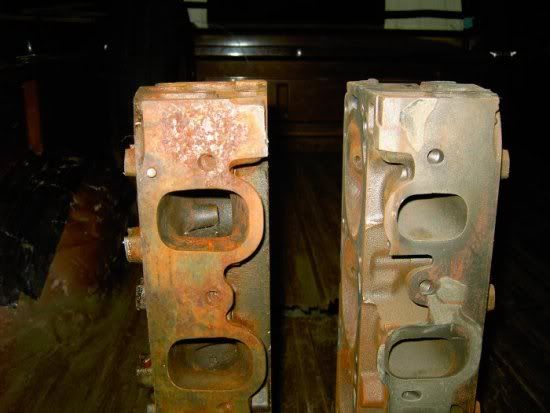
OP. This is an M head, but its pretty much the same as a 2V head. See the top where there is a bit of paint showing on the corners? That is where you will find a 2 or a 4, if it doesnt have anything there like this head, its a 2V M head. Very easy way to tell if you have a 2V or 4V if it has an aftermarket 4 barrel intake.

Just for fun and basic info.. The left head is a 4V, the right one is a 2V. There is a bit of a difference in the ports, wouldnt you agree?
The 270H makes lots of bottom end, it has power right off idle, fun cam. The 262H works good too, and it wont lope quite as much, havent run one of those in a 4V yet. The 274XE in the Cougar is a bit large for wanting economy, and it will need more stall or gears. Have you tried the smaller XE in the 260s? I dont remember what they call it right now and I dont want to bother to look it up.I tend to put new valves in since I dont trust the really old ones anymore, lost a 4V to one of them. Even my Pontiacs get new valves now, just peace of mind really.
OP. This is an M head, but its pretty much the same as a 2V head. See the top where there is a bit of paint showing on the corners? That is where you will find a 2 or a 4, if it doesnt have anything there like this head, its a 2V M head. Very easy way to tell if you have a 2V or 4V if it has an aftermarket 4 barrel intake.
Just for fun and basic info.. The left head is a 4V, the right one is a 2V. There is a bit of a difference in the ports, wouldnt you agree?

3rd Gear Member
Joined: Aug 2006
Posts: 886
From: North East Texas on the Red River
Yes, loosing a valve and suffering the consequences would definitely alter your parts replacement list.
All this Cleveland talk is starting me thinking about a 2V engine and transmission that I know of for sale. I'm not an automatic transmission, guy and he won't split it. I don't think the transmission would bring much. If it weren't for the header issue I wouldn't hesitate building it for an upcoming project in lieu of a 347. I might start seeing what is available in the way of headers that I can modify for my uses.
All this Cleveland talk is starting me thinking about a 2V engine and transmission that I know of for sale. I'm not an automatic transmission, guy and he won't split it. I don't think the transmission would bring much. If it weren't for the header issue I wouldn't hesitate building it for an upcoming project in lieu of a 347. I might start seeing what is available in the way of headers that I can modify for my uses.

2nd Gear Member
Joined: Aug 2009
Posts: 475
From: Nebraska
Up until two weeks ago i would have disagreed with you on this. However my freshly rebuild 351c 4v had the #3 exhaust valve break off during cam break in. I got her started up and run up to 2500. About 10 minutes into it, out comes a big cloud of white smoke and she sputters out. When i look under her there is about a gallon of coolant out the exaust and coolant dripping off the #3 header port. Pulled the plugs out and the #3 was trashed. Pulled the motor out and i stuck my finger into the #3 exaust port and i could feel the valve sitting sideways. Its at the machinest now and i am waiting for word as to what else is screwed up. I have my fingers crossed that the head is still good. That much coolant and none in the oil doesnt have me very hopefull though.