


rearend vibration


Thread Starter
6th Gear Member
Joined: Oct 2006
Posts: 6,417
From: Cork, Ireland
 rearend vibration
so I had a bit of time to look under the car.
Last thing I did was to add a wedge under the rear axel to bring the pinion further up.
I am certain that all parts engine, gearbox, rearlaxle (complete), wheels and tyres are ok. they are all new, the driveshaft is 2nd hand frokmm unknown car.
with the addition of the wegde the vibration starts at 80mph (not at 65 as before).
I drove it like that for maybe 2months, last night I measured again.
I measure the angle of the car at doorsill and that seemed 0 degrees.
The driveshaft as well is 0 degrees, which means it seems parallel to car.
The tailshaft of the gearbox is pointing downwards by 5 degrees (i end up with measurements between 4.5 and 5.5 depending where exactly I measure).
the pinion angle seems to be the same thing 4.5 to 5.5 up. sometimes I measure just above 4.5 and sometimes below 5.5. the instrument is not good enough to measure to half degrees.
So from this I have the same angle opposite direction at the u-joints, which is what it should be.
the only thing I could think of improving here is that I might raise the gearbox (if possible at all) and lower the pinion again, to get the working angle of the u-joints better. But I always thought that 5 degrees is acceptable value.
I measured from fraimrailes to gearbox and the tailshaft is centered in car, the same with the pinion. so I don't seem to have any sideways angles.
Is a new driveshaft in order (that would explain my problems, who knows it's used off ebay and could have come out of a crashed car for all I know), or should I try to lift the tailshaft and lower the pinion?
basically ... is this acceptable??????
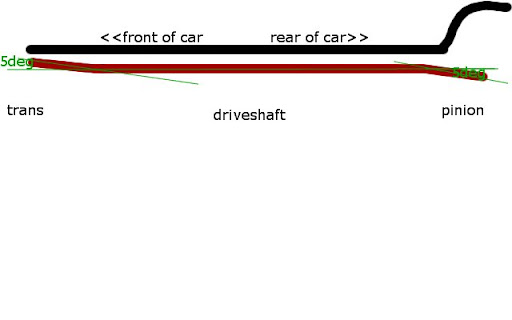
sorry the crap drawing ...
Last thing I did was to add a wedge under the rear axel to bring the pinion further up.
I am certain that all parts engine, gearbox, rearlaxle (complete), wheels and tyres are ok. they are all new, the driveshaft is 2nd hand frokmm unknown car.
with the addition of the wegde the vibration starts at 80mph (not at 65 as before).
I drove it like that for maybe 2months, last night I measured again.
I measure the angle of the car at doorsill and that seemed 0 degrees.
The driveshaft as well is 0 degrees, which means it seems parallel to car.
The tailshaft of the gearbox is pointing downwards by 5 degrees (i end up with measurements between 4.5 and 5.5 depending where exactly I measure).
the pinion angle seems to be the same thing 4.5 to 5.5 up. sometimes I measure just above 4.5 and sometimes below 5.5. the instrument is not good enough to measure to half degrees.
So from this I have the same angle opposite direction at the u-joints, which is what it should be.
the only thing I could think of improving here is that I might raise the gearbox (if possible at all) and lower the pinion again, to get the working angle of the u-joints better. But I always thought that 5 degrees is acceptable value.
I measured from fraimrailes to gearbox and the tailshaft is centered in car, the same with the pinion. so I don't seem to have any sideways angles.
Is a new driveshaft in order (that would explain my problems, who knows it's used off ebay and could have come out of a crashed car for all I know), or should I try to lift the tailshaft and lower the pinion?
basically ... is this acceptable??????
sorry the crap drawing ...

Thread Starter
6th Gear Member
Joined: Oct 2006
Posts: 6,417
From: Cork, Ireland
thanks a million for confirming that 2+2. car was sitting on pretty flat ground (buddys garage with pit) on it's own tyres directly after a drive. basically the same way as driven.
I'll try a new shaft now and see what happens from there. I never trusted that thing anyway. should have done it proper first day. I'll get new joints with it as well which is a bonus.
I'll try a new shaft now and see what happens from there. I never trusted that thing anyway. should have done it proper first day. I'll get new joints with it as well which is a bonus.

2nd Gear Member
Joined: Dec 2005
Posts: 439
From: MO
Most of what I have read (e.g. 'How to Build Ford Restomod Street Machines' by Tony Huntimer) say you want no more than 7* TOTAL - that would be a max of 3.5 degree on each end ('The combined pinion and transmission angle should not exceed more than 7 degrees', p. 53). You probably have too much on both ends. Get it down to about 3* on each end and it will probably help (as well as make your u-joints last). Mine is about 2.5* on each end.
Last edited by ozarks06; May 4, 2010 at 09:30 AM.

5th Gear Member
Joined: Apr 2007
Posts: 2,100
From: Texas Hill Country
I have that book but do not remember that section. I will have to look for my source to confirm, but I have in my mind that a ladder-bar suspension normally requires ½ degree of pinion angle, a four-link requires 1-2½ degrees, and a leaf-spring suspension requires up to 6 to 7 degrees (pinion is noise down with relation to driveshaft). Basically leaf springs do not control the pinion angle very well as power is applied so it requires more initial angle to allow for pinion walk up. You do not want the angle from the driveshaft to the pinion to approach 0. I also have in my mind that the pinion angle and transmission angle with relation to the driveshaft should be equal but opposite.
You are within all those ranges; however, your pinion angle is NOT negative with relation to the driveshaft. In your case, the more power you plant, the further from 0 your pinion angle will be...thus creating more vibration from more u joint angle. The overall goal is for under power there to be close to a straight line from the transmission through the differential. In your case, as power increases, the line gets more broken NOT more straight. My 2 cents is your pinion is point up when it should be pointing down.
How did you measure? Did you remove the driveshaft to measure the tranny and pinion angles?
I found one source.
http://www.carcraft.com/howto/91758/index.html
You are within all those ranges; however, your pinion angle is NOT negative with relation to the driveshaft. In your case, the more power you plant, the further from 0 your pinion angle will be...thus creating more vibration from more u joint angle. The overall goal is for under power there to be close to a straight line from the transmission through the differential. In your case, as power increases, the line gets more broken NOT more straight. My 2 cents is your pinion is point up when it should be pointing down.
How did you measure? Did you remove the driveshaft to measure the tranny and pinion angles?
I found one source.
http://www.carcraft.com/howto/91758/index.html
2nd Gear Member
Joined: Dec 2005
Posts: 439
From: MO
That is true, but the angles still need to be less than 7* total. Huntimer says to point the pinion nose down with leaf springs since they wrap up under load and the pinion will point up then. I tried that but had too much vibration in normal driving. I have Maier Racing springs that don't wrap much at all. (I also think he assumes you're not building a street-driven restomod but more of a track car.) I have my pinion about 2.5* up and the tranny 2.5* down, which keeps it pretty close and smooth for normal driving (the pinion probably comes up another degree or 2 under hard load, but with an old guy driving, that is not real often, not at every light anyway).
The Car Craft article says you want no more than 3 deg on each u-joint, and ideally, the tranny down and the pinion up (which, with leaf springs probably assumes under load). Good article.
I think you have the right directions (for normal driving) but too much angle on each end.
The Car Craft article says you want no more than 3 deg on each u-joint, and ideally, the tranny down and the pinion up (which, with leaf springs probably assumes under load). Good article.
I think you have the right directions (for normal driving) but too much angle on each end.
Last edited by ozarks06; May 4, 2010 at 10:08 AM.
Thread Starter
6th Gear Member
Joined: Oct 2006
Posts: 6,417
From: Cork, Ireland
i measured the driveshaft in car, then I removed driveshaft and measured with the yoke turn so i would get a flat surface. If I remove my shim (i don't remember what size it was anymore. 2 or 4 degrees) the vibration will just start at 50mph again.
I do understand that it might be better to have it angled 1 or 2 degrees off, but my problem is accellerating slowly into 80 already. as soon as I hit 80 the vibrations start to go mad and it doesn't matter if i accellerate, decellerate or cruise.
So the problem might be the working angle is wrong (as ozarks says), so the solution would be to lower the pinion angle again (remove shim) and raise the transmission at the back.
Well I could give that a try without any cost, so I'll do that first. However there is very very very little room between the T5 and a floorpan strenghtening. maybe only half inch. So I don't see how I can possibly bring it up more. unless bringing the tailshaft up by 5mm would already have an affect of lets say 3 degrees ... will need to get the tape measurer and the calculator out. another option would be to drop the engine a bit down. but i can't see that to work without spending plenty of money with adjustable engine mounts
I do understand that it might be better to have it angled 1 or 2 degrees off, but my problem is accellerating slowly into 80 already. as soon as I hit 80 the vibrations start to go mad and it doesn't matter if i accellerate, decellerate or cruise.
So the problem might be the working angle is wrong (as ozarks says), so the solution would be to lower the pinion angle again (remove shim) and raise the transmission at the back.
Well I could give that a try without any cost, so I'll do that first. However there is very very very little room between the T5 and a floorpan strenghtening. maybe only half inch. So I don't see how I can possibly bring it up more. unless bringing the tailshaft up by 5mm would already have an affect of lets say 3 degrees ... will need to get the tape measurer and the calculator out. another option would be to drop the engine a bit down. but i can't see that to work without spending plenty of money with adjustable engine mounts
5th Gear Member
Joined: Apr 2007
Posts: 2,100
From: Texas Hill Country
Before I get started, let me say that I know this will be a lot of work but based on my reading, I think it may help. You have the transmission angle and pinion angle parallel which is very good, but:
1. Your angle between the driveshaft and tranny is more than 3*
2. Your angle between the driveshaft and pinion is more than 3*
3. As you apply power, your pinion to driveshaft angle increase (gets higher) thus becoming less parrallel and further from the magic 3*
I would:
1. Try to raise the transmission tailshaft so that the transmission to driveshaft angle is less. Getting it close to level with relation to the driveshaft would be good (close to 0* tranny to driveshaft angle). This will be hard, I know. Yes, I would think lower engine mounts would help because dropping the front of the engine is the same as raising the tailshaft of the tranny with relation to the affects on the driveshaft angle.
2. After you get your tranny angle changed, try matching the pinion angle to it or slightly less. I believe your pinion is higher from the ground than your tranny...is that correct? If so, you cannot get the negative pinion angle, so get it close to 0 so when the pinion walks up it will not put you out of spec.
Make since? Let me know about the tranny to ground vs. pinion to ground measurement. Many of the pictures and diagrams assume the tranny is higher than the pinion which will give you a negative pinion to driveshaft angle...this is ideal but may not be possible in your car.
Read this. It is very good information. It is from Inland Empire Driveline's knowledge section. As they point out, it is only when the pinion is higher than the tranny that there is an issue with hotrods because this condition creates larger angles (ujoints like less than 5*) and the pinion walk puts you farther away from the no vibration point of 0*.
http://www.iedls.com/asp/admin/getFi...&TID=28&FN=PDF
1. Your angle between the driveshaft and tranny is more than 3*
2. Your angle between the driveshaft and pinion is more than 3*
3. As you apply power, your pinion to driveshaft angle increase (gets higher) thus becoming less parrallel and further from the magic 3*
I would:
1. Try to raise the transmission tailshaft so that the transmission to driveshaft angle is less. Getting it close to level with relation to the driveshaft would be good (close to 0* tranny to driveshaft angle). This will be hard, I know. Yes, I would think lower engine mounts would help because dropping the front of the engine is the same as raising the tailshaft of the tranny with relation to the affects on the driveshaft angle.
2. After you get your tranny angle changed, try matching the pinion angle to it or slightly less. I believe your pinion is higher from the ground than your tranny...is that correct? If so, you cannot get the negative pinion angle, so get it close to 0 so when the pinion walks up it will not put you out of spec.
Make since? Let me know about the tranny to ground vs. pinion to ground measurement. Many of the pictures and diagrams assume the tranny is higher than the pinion which will give you a negative pinion to driveshaft angle...this is ideal but may not be possible in your car.
Read this. It is very good information. It is from Inland Empire Driveline's knowledge section. As they point out, it is only when the pinion is higher than the tranny that there is an issue with hotrods because this condition creates larger angles (ujoints like less than 5*) and the pinion walk puts you farther away from the no vibration point of 0*.
http://www.iedls.com/asp/admin/getFi...&TID=28&FN=PDF
Last edited by urban_cowboy; May 4, 2010 at 11:29 AM.