


295/45/18


4th Gear Member
Joined: Oct 2007
Posts: 1,778
From: Harrisburg PA

The upside of going with a taller tire, is more tire contact with the ground and possibly better traction. Example: Take two balloons, one larger than the other and place them both on a flat surface. The larger balloon will have more balloon touching the surface. Or something along these lines that I've read before.
Everything I have said is based on what I've been told, and what kind of makes sense. So if someone else would chime in that knows more on the subject, feel free to correct.
Everything I have said is based on what I've been told, and what kind of makes sense. So if someone else would chime in that knows more on the subject, feel free to correct.
But....its not true. Here is the equation governing contact patch:
Contact Patch = weight/pressure
This means - when you put two balloons (one small and one large) on a surface, with the same air pressure inside and assuming they weigh the same...their contact patch size will be exactly the same.
The same is not quite true with tires (although there are many who will debate this) but its reasonably close. You can Google 'Contact Patch' to read more about this. Or here is a link to a good reference: Tire Contact Patch Size

5th Gear Member
Joined: Jan 2006
Posts: 2,398
From: Florida
Contact Patch size is a confusing subject. I'm not going to claim to be an expert but its a subject I've looked into because, just like you, I intuitively thought the bigger ballon (or tire) would have a larger contact patch.
But....its not true. Here is the equation governing contact patch:
Contact Patch = weight/pressure
This means - when you put two balloons (one small and one large) on a surface, with the same air pressure inside and assuming they weigh the same...their contact patch size will be exactly the same.
The same is not quite true with tires (although there are many who will debate this) but its reasonably close. You can Google 'Contact Patch' to read more about this. Or here is a link to a good reference: Tire Contact Patch Size
But....its not true. Here is the equation governing contact patch:
Contact Patch = weight/pressure
This means - when you put two balloons (one small and one large) on a surface, with the same air pressure inside and assuming they weigh the same...their contact patch size will be exactly the same.
The same is not quite true with tires (although there are many who will debate this) but its reasonably close. You can Google 'Contact Patch' to read more about this. Or here is a link to a good reference: Tire Contact Patch Size
Hey Argonaut,
Thanks for the read. I'm not sure if that quite determines if over-all increase in diameter would increase contact patch though. I agree, tire pressure and weight would be major factors... though I also think an increase in tire diameter would also net some effect towards contact patch.
After all, if you increase the diameter and keep the same load... the weight has to be evenly distributed and thus the tire would have more planted on the ground... I mean, atleast in my mind. You can't expect a 225/30/10 (random number) to have the same contact patch as a 235/55/17, just as it wouldn't make sense for any smaller tire to have the same contact patch as a larger tire.
I could be 100% wrong, or not... some proof on the subject would be needed.
Last edited by Menace; Aug 25, 2010 at 08:38 AM.

6th Gear Member
Joined: Jul 2007
Posts: 6,130
From: Honolulu, HI
i have Nitto 555's 295/45-18 in back
i like the ride and the look better than the 20's i used to have
if they are much heavier than before, i dont really notice
probly with the 4.10's and Whipple the bigger tire works out pretty well.
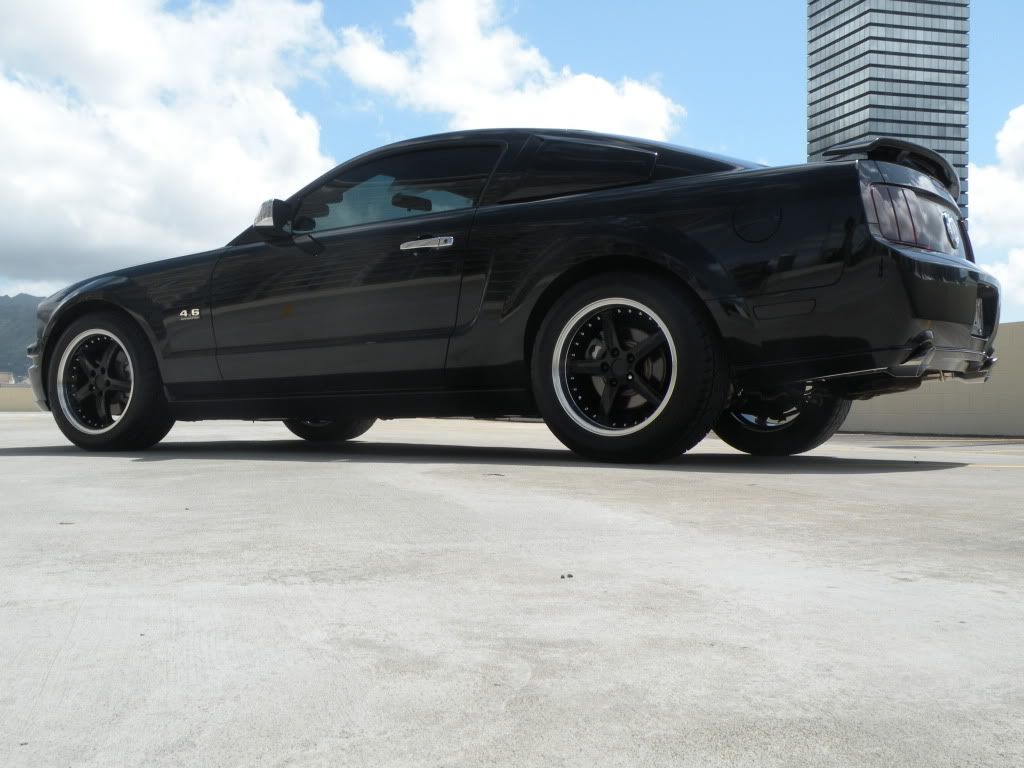
i like the ride and the look better than the 20's i used to have
if they are much heavier than before, i dont really notice
probly with the 4.10's and Whipple the bigger tire works out pretty well.

6th Gear Member
Joined: Feb 2007
Posts: 7,635
From: state of confusion
Menace -
Once you're looking at the sort of change that might result from an inch or two of overall diameter increase, you need to start looking at things like tire carcass stiffness, non-uniformity of contact patch loading (which is nowhere near constant like weight divided by inflation pressure suggests but may vary over a 2:1 range - even if as an "overall average" it may end up being close to weight ÷ psi), and actual tread area (ignoring the "void area" which contributes zero grip). Probably more important is the shape of the contact patch relative to what direction you're asking the tire to mostly work in - longitudinally (acceleration/braking) or laterally (cornering).
Norm
Once you're looking at the sort of change that might result from an inch or two of overall diameter increase, you need to start looking at things like tire carcass stiffness, non-uniformity of contact patch loading (which is nowhere near constant like weight divided by inflation pressure suggests but may vary over a 2:1 range - even if as an "overall average" it may end up being close to weight ÷ psi), and actual tread area (ignoring the "void area" which contributes zero grip). Probably more important is the shape of the contact patch relative to what direction you're asking the tire to mostly work in - longitudinally (acceleration/braking) or laterally (cornering).
Norm
Last edited by Norm Peterson; Aug 25, 2010 at 12:24 PM.
4th Gear Member
Joined: Oct 2007
Posts: 1,778
From: Harrisburg PA
Hey Argonaut,
Thanks for the read. I'm not sure if that quite determines if over-all increase in diameter would increase contact patch though. I agree, tire pressure and weight would be major factors... though I also think an increase in tire diameter would also net some effect towards contact patch.
After all, if you increase the diameter and keep the same load... the weight has to be evenly distributed and thus the tire would have more planted on the ground... I mean, atleast in my mind. You can't expect a 225/30/10 (random number) to have the same contact patch as a 235/55/17, just as it wouldn't make sense for any smaller tire to have the same contact patch as a larger tire.
I could be 100% wrong, or not... some proof on the subject would be needed.
Thanks for the read. I'm not sure if that quite determines if over-all increase in diameter would increase contact patch though. I agree, tire pressure and weight would be major factors... though I also think an increase in tire diameter would also net some effect towards contact patch.
After all, if you increase the diameter and keep the same load... the weight has to be evenly distributed and thus the tire would have more planted on the ground... I mean, atleast in my mind. You can't expect a 225/30/10 (random number) to have the same contact patch as a 235/55/17, just as it wouldn't make sense for any smaller tire to have the same contact patch as a larger tire.
I could be 100% wrong, or not... some proof on the subject would be needed.
As the article I linked to points out, it is not really true for tires. The article does use real data to determine that as the *width* of a tire increases its contact patch does increase, but not nearly as much you'd think. It also indicates that the increase in contact patch is not linear with tire pressure or load, i.e. at low and high psi and load measurements the contact patch increases with width much more than it does at real operating pressures we use. So, in other words, the intuitive thought that a wider tire = more contact patch has some truth to it...but other factors, like Norm points out, have a much bigger impact.
The article does not however discuss changing diameter of a tire (the subject you brought up) and what impact it has on contact patch. At least it doesn't discuss it directly although radius is one of the measurements the article uses. Thus it doesn't address your hypothesis that a tire with larger diameter has more rubber on the road and "possibly better traction".
None-the-less the bottom line is - tires are very, very complex and there are no rules of thumb that apply to all situations. We can not say that a wider tire = more contact and thus more grip for example, its too general of a statement. The only correct answer is: it depends! I.e. it depends on a huge number of factors - tire compound, construction, car weight, temperatures, pressures, etc, etc. I'm pretty certain this would also apply to diameter but as you say...show me the data.

5th Gear Member
Joined: Jan 2006
Posts: 2,398
From: Florida
Yep, I agree with both of you.
There are many factors involved, but maybe it's just me convincing myself that the wider/taller tire will benefit my needs. I think the increase size will have effect, both the width and height, on the contact patch and possibly benefit me in some straight line acceleration ( I have no experience in the field of autox or anything, so I won't even go there )
Whether it does or not, it wasn't my reason for getting the tire, just an added bonus. The width, and "meaty" look of the tire was my reason. Just wanted to give everything for the op to make his decision. Or else you could just go with a 285/40/18 which is the same height more or less as a 255/45/18 so you'll have an even front and back staggered setup, and these are both options that are the same height as your stock setup so it's the perfect replacement. I just wanted something larger in the back and am fully satisfied. Tires have like 10 miles on them, so it'll be a while and some driving to determine if I will keep a 295/45/18 in the back, but again right now I am 100% satisfied.
There are many factors involved, but maybe it's just me convincing myself that the wider/taller tire will benefit my needs. I think the increase size will have effect, both the width and height, on the contact patch and possibly benefit me in some straight line acceleration ( I have no experience in the field of autox or anything, so I won't even go there )
Whether it does or not, it wasn't my reason for getting the tire, just an added bonus. The width, and "meaty" look of the tire was my reason. Just wanted to give everything for the op to make his decision. Or else you could just go with a 285/40/18 which is the same height more or less as a 255/45/18 so you'll have an even front and back staggered setup, and these are both options that are the same height as your stock setup so it's the perfect replacement. I just wanted something larger in the back and am fully satisfied. Tires have like 10 miles on them, so it'll be a while and some driving to determine if I will keep a 295/45/18 in the back, but again right now I am 100% satisfied.

Thread Starter
2nd Gear Member
Joined: Feb 2010
Posts: 275
From: NJ
Unfortunately, the 295/45 tire is twice the cost of a 285/40 tire. I prefer the meatier tire, but I will have to sacrifice in this instance.
Thank you all for your responses. I definitely have a better understanding of it.
Thank you all for your responses. I definitely have a better understanding of it.
5th Gear Member
Joined: Jan 2006
Posts: 2,398
From: Florida
I would disagree with your pricing. Cruizinconcepts, a sponsor of this site has Nitto 285/40/18 for $206, free shipping. They also have Nitto 295/45/18 for $212, free shipping. It's no surprise that the larger tire isn't that much more expensive. The 285 is more of a direct replacement, and thus is favored. If everyone enjoyed the look of the 295, it would drive the price up. Some do, most don't is my best understanding, or maybe some just don't know. Hope this helps.
http://www.cruizinconceptswholesale....ts.asp?cat=289
http://www.cruizinconceptswholesale....ts.asp?cat=289