


Cams


Guest
Posts: n/a
 RE: Cams
Most modern engines have what are called overhead cams. This means that the camshaft is located above the valves. The cams on the shaft activate the valves directly or through a very short linkage. Older engines used a camshaft located in the sump near the crankshaft. Rods linked the cam below to valve lifters above the valves. This approach has more moving parts and also causes more lag between the cam's activation of the valve and the valve's subsequent motion. A timing belt or timing chain links the crankshaft to the camshaft so that the valves are in sync with the pistons. The camshaft is geared to turn at one-half the rate of the crankshaft. Many high-performance engines have four valves per cylinder (two for intake, two for exhaust), and this arrangement requires two camshafts per bank of cylinders, hence the phrase "dual overhead cams."
The camshaft uses lobes (called cams) that push against the valves to open them as the camshaft rotates; springs on the valves return them to their closed position. This is a critical job, and can have a great impact on an engine's performance at different speeds.

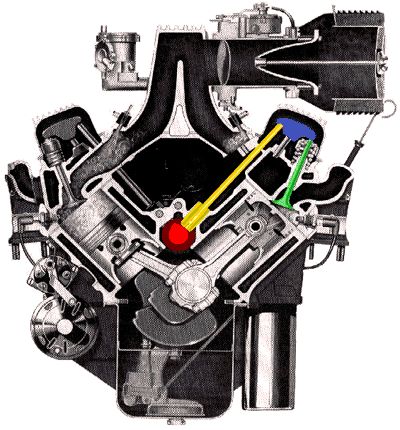 Red part is the camshaft on this V8
Hope that made sense.
The camshaft uses lobes (called cams) that push against the valves to open them as the camshaft rotates; springs on the valves return them to their closed position. This is a critical job, and can have a great impact on an engine's performance at different speeds.
Red part is the camshaft on this V8Hope that made sense.

5th Gear Member
Joined: Mar 2004
Posts: 3,594
From:
RE: Cams
ORIGINAL: FordRacer
Most modern engines have what are called overhead cams. This means that the camshaft is located above the valves. The cams on the shaft activate the valves directly or through a very short linkage. Older engines used a camshaft located in the sump near the crankshaft. Rods linked the cam below to valve lifters above the valves. This approach has more moving parts and also causes more lag between the cam's activation of the valve and the valve's subsequent motion. A timing belt or timing chain links the crankshaft to the camshaft so that the valves are in sync with the pistons. The camshaft is geared to turn at one-half the rate of the crankshaft. Many high-performance engines have four valves per cylinder (two for intake, two for exhaust), and this arrangement requires two camshafts per bank of cylinders, hence the phrase "dual overhead cams."
The camshaft uses lobes (called cams) that push against the valves to open them as the camshaft rotates; springs on the valves return them to their closed position. This is a critical job, and can have a great impact on an engine's performance at different speeds.
Red part is the camshaft on this V8
Hope that made sense.
Most modern engines have what are called overhead cams. This means that the camshaft is located above the valves. The cams on the shaft activate the valves directly or through a very short linkage. Older engines used a camshaft located in the sump near the crankshaft. Rods linked the cam below to valve lifters above the valves. This approach has more moving parts and also causes more lag between the cam's activation of the valve and the valve's subsequent motion. A timing belt or timing chain links the crankshaft to the camshaft so that the valves are in sync with the pistons. The camshaft is geared to turn at one-half the rate of the crankshaft. Many high-performance engines have four valves per cylinder (two for intake, two for exhaust), and this arrangement requires two camshafts per bank of cylinders, hence the phrase "dual overhead cams."
The camshaft uses lobes (called cams) that push against the valves to open them as the camshaft rotates; springs on the valves return them to their closed position. This is a critical job, and can have a great impact on an engine's performance at different speeds.
Red part is the camshaft on this V8Hope that made sense.
valve lifters on CIB engines are just above the cam not the valve. the cam in a CIB engine is not in the sump, but centrally located in the block far above the sump which is located below the crank
OHC engines use followers not lifters but essentially the same thing
not all 4V engines are DOHC many are SOHC like the Chrysler 3.5L and Mitsu 3.0L or Escort 1.6/1.9
there are also 4V heads for CIB engines they are rare and expensive but still exist
the more moving parts has nothing to do with lag but power robbing friction
the real issue is allowing more air/fuel mix into and out of an engine
the camber is the amount of height above a perfect circle the lobe is. this is called cam lift. multiplied by the rocker ratio gives valve lift
for instance if you have a .305" cam lobe lift and have 1.8 ratio rocker arms you multiply .305 times 1.8 which gives .549" valve lift.
the easiest way to gain lift on the ford 3.8 is to add 1.8 roller rockers. these add about .020" valve lift while also reducing friction over the stock design. this will add 7-10 hp.
they are a nice start to a stock engine and with adjustable rockers can be used for reground (small base circle) cams
www.rpm-mustangs.com has a nice selection of cams for the 3.8
comp cams also has a new line of cams for the 3.8 ford

Thread
Thread Starter
Forum
Replies
Last Post
junior04
4.6L (1996-2004 Modular) Mustang
1
Sep 28, 2015 10:53 AM