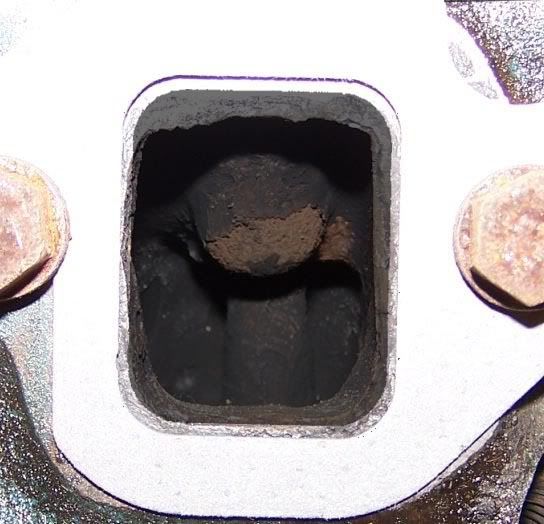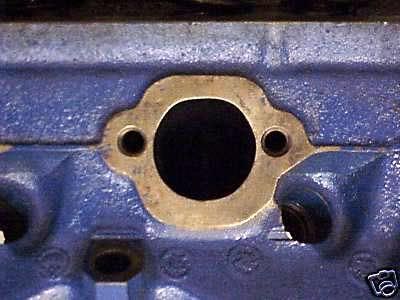


300hp from 289


6th Gear Member
Joined: Feb 2005
Posts: 13,396
From: KY

There have been a couple of threads about this recently, so I will keep it short.
A 289 is not going to produce a bunch of torque due to the short stroke of the crank. Power is a function of torque and rpm. That being said, a 289 or 302 or any other short stroke engine can make decent power, but it requires spinning the motor at higher rpms. This is not usually conducive to street driving which is why strokers are so popular. The added torque they produce gives power in the streetable rpms.
Regardless, you can build out a nice 289 or 302 that will turn high rpms and make power, but that may not be what you are after. Running an engine at 4000-6000 rpm to build power during a cruise is not what some people want to do.
If you are racing the car, then 300hp at the rear wheels from a 289 is very doable. If you are going to cruise the car, you should be more concerned about what the torque and horsepower is at 1500-3500rpm than what the peak power is because this is the range you will probably be driving in. Personally, my street/strip '69 engine never sees below 2500, but that is the exception more than the rule and I break lots of stuff .
.
A 289 is not going to produce a bunch of torque due to the short stroke of the crank. Power is a function of torque and rpm. That being said, a 289 or 302 or any other short stroke engine can make decent power, but it requires spinning the motor at higher rpms. This is not usually conducive to street driving which is why strokers are so popular. The added torque they produce gives power in the streetable rpms.
Regardless, you can build out a nice 289 or 302 that will turn high rpms and make power, but that may not be what you are after. Running an engine at 4000-6000 rpm to build power during a cruise is not what some people want to do.
If you are racing the car, then 300hp at the rear wheels from a 289 is very doable. If you are going to cruise the car, you should be more concerned about what the torque and horsepower is at 1500-3500rpm than what the peak power is because this is the range you will probably be driving in. Personally, my street/strip '69 engine never sees below 2500, but that is the exception more than the rule and I break lots of stuff
.why does it have to be a race car to want to turn some rpm?

3rd Gear Member
Joined: Aug 2006
Posts: 886
From: North East Texas on the Red River
It seems that Cowboy and myself are on the same page so I will respond to the last post.
There is absolutely no rule that says that it has to be a race car to turn high RPM. That said, spinning an engine 6,000, 6,500 or beyond regularly, is not an ideal situation for a street car. An engine with more low and mid range torque is much more fun and practical for the street, not to mention much more long lived. High RPM is TOUGH on an engine!
My $0.02,
There is absolutely no rule that says that it has to be a race car to turn high RPM. That said, spinning an engine 6,000, 6,500 or beyond regularly, is not an ideal situation for a street car. An engine with more low and mid range torque is much more fun and practical for the street, not to mention much more long lived. High RPM is TOUGH on an engine!
My $0.02,

6th Gear Member
Joined: May 2009
Posts: 5,232
From: PA
A 300 hp 289 is easy to do, you don't even need aftermarket heads, the stock iron ones can easily accommodate that much power. Screw-in rocker studs with stock rockers, hydraulic cam, dual-plane 4V manifold, stock ignition are all that's required. You only need to do it right, not expensive. 6000 rpm once in a while should not be a problem for a 289, the bottom is not weak. Better con rod bolts might be in order, while you're in there. You won't be using a flat tappet hydraulic above 6000 anyway.

2nd Gear Member
Joined: Sep 2009
Posts: 224
From: Central PA
The car performs really nicely, has a good idle and excellent street manners. We can cruise it all day in traffic with no problems.
I've thought about putting a more aggressive grind in, but it's my wife's car, and she's happy with the performance. I could probably get 300 rwhp out of the existing setup with a significantly hotter cam, but it definitely would have much poorer street manners.
Besides, we have our Mach if we really wanna go
 .
.

6th Gear Member
Joined: Apr 2007
Posts: 10,468
From: California
I'm making a little over 300rwhp and shift at 6,300rpm. I run that engine up over 6,000rpm on a daily basis(multiple times per day actually). It has plenty of street manners and excellent bottom end torque(I'll pull up hills in 5th gear at 1,500rpm sometimes). That said, nothing in it is stock. Rods, crank(replaced due to damage, the stock crank is fine for that though), valvetrain....everything has been replaced. It costs money to build an engine that you can turn higher rpm reliably. 6,500rpm isn't much for a decent 302, short stroke and short deck height(meaning short pushrods) don't mind rpm all that much. My engine spends 90% of it's life between 1,500 and 3,000rpm, and virtually all of it's cruise time at 2,000-2,200 though.
A street 289/302 can make 300hp at the crank without having to turn 6,000rpm with either well ported stock heads, or decent aftermarket heads, and a good hyd or hyd roller cam. ARP rod bolts are a MINIMUM, and ALWAYS invest in a sound valvetrain.
It really comes down to how much money you want to spend. Cheap, powerful, reliable....pick 2.
And there is NO WAY in hell an '88 Camaro is putting 275 to the wheels stock. Not with the stock 305 that only made 170 at the crank anyway. They were more like 125rwhp, which incidentally isn't much less than what the typical 4bbl 289/302 from the 60's and 70's made. For comparison, the LT1 5.7L was 275 at the crank, and around 210-220rwhp, though they did make decent torque(and modified can make a lot of power). The LS1 is around 340-360 at the crank(yes, the Camaro and Vette had the EXACT same engine and the Camaro was way under rated so the Vette owners wouldn't get their panties in a wad), and typically would come in anywhere from 275-300rwhp. The newer 6.0L LS2 is 400 at the crank, and comes in at around 345rwhp.
Ford by comparison...the 5.0L Cobra engine was around 260-270 at the crank and would come in around 220rwhp, the 2V Modular OHC at it's peak before the 3V was rated at 260 crank and was around 210rwhp. The 3V in the 2005-up Mustangs is rated 300 crank and comes in typically at 240-260rwhp.
Keep in mind that nearly all dyno numbers are somewhat subjective. But it gives you an idea. And again, it gets back to how much you want to spend and what you want out of the car.
A street 289/302 can make 300hp at the crank without having to turn 6,000rpm with either well ported stock heads, or decent aftermarket heads, and a good hyd or hyd roller cam. ARP rod bolts are a MINIMUM, and ALWAYS invest in a sound valvetrain.
It really comes down to how much money you want to spend. Cheap, powerful, reliable....pick 2.
And there is NO WAY in hell an '88 Camaro is putting 275 to the wheels stock. Not with the stock 305 that only made 170 at the crank anyway. They were more like 125rwhp, which incidentally isn't much less than what the typical 4bbl 289/302 from the 60's and 70's made. For comparison, the LT1 5.7L was 275 at the crank, and around 210-220rwhp, though they did make decent torque(and modified can make a lot of power). The LS1 is around 340-360 at the crank(yes, the Camaro and Vette had the EXACT same engine and the Camaro was way under rated so the Vette owners wouldn't get their panties in a wad), and typically would come in anywhere from 275-300rwhp. The newer 6.0L LS2 is 400 at the crank, and comes in at around 345rwhp.
Ford by comparison...the 5.0L Cobra engine was around 260-270 at the crank and would come in around 220rwhp, the 2V Modular OHC at it's peak before the 3V was rated at 260 crank and was around 210rwhp. The 3V in the 2005-up Mustangs is rated 300 crank and comes in typically at 240-260rwhp.
Keep in mind that nearly all dyno numbers are somewhat subjective. But it gives you an idea. And again, it gets back to how much you want to spend and what you want out of the car.
6th Gear Member
Joined: Jan 2007
Posts: 5,469
From: AR
Just to elaborate and to try and **** some folks off, IMO the 289/302 is of a better design than a SBC.
I can remember when I owned my 90 Mustang, it would get up and go pretty good, (good enough to smoke the firechickens and Camaros of the era) and still had excellent street manners.
IMo a SBC (either 305 OR 350) don't have **** on a SBF, ESPECIALLY when aftermarket heads are used. Yea, there is more AVAILABLE for the SBC, but considering what is available for a SBF this is a moot point as well.
I can remember when I owned my 90 Mustang, it would get up and go pretty good, (good enough to smoke the firechickens and Camaros of the era) and still had excellent street manners.
IMo a SBC (either 305 OR 350) don't have **** on a SBF, ESPECIALLY when aftermarket heads are used. Yea, there is more AVAILABLE for the SBC, but considering what is available for a SBF this is a moot point as well.
6th Gear Member
Joined: Apr 2007
Posts: 10,468
From: California
I'm generally going to agree with that. It's primarily the heads, SBF has a superior port design and port/valve layout when compared to a SBC. For the same cubes, rpm and quality parts, the SBF typically makes better power.
6th Gear Member
Joined: Feb 2005
Posts: 13,396
From: KY
It seems that Cowboy and myself are on the same page so I will respond to the last post.
There is absolutely no rule that says that it has to be a race car to turn high RPM. That said, spinning an engine 6,000, 6,500 or beyond regularly, is not an ideal situation for a street car. An engine with more low and mid range torque is much more fun and practical for the street, not to mention much more long lived. High RPM is TOUGH on an engine!
My $0.02,
There is absolutely no rule that says that it has to be a race car to turn high RPM. That said, spinning an engine 6,000, 6,500 or beyond regularly, is not an ideal situation for a street car. An engine with more low and mid range torque is much more fun and practical for the street, not to mention much more long lived. High RPM is TOUGH on an engine!
My $0.02,
every heard of a 2v or 4v motor? those motors will pull above 6,000 rpm and people daily drive them. Then again they are trucks are people pull all kinds of things with these motors
6th Gear Member
Joined: May 2009
Posts: 5,232
From: PA