


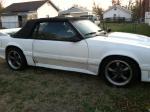
My first mustang!!


4th Gear Member
Joined: Jan 2007
Posts: 1,282
From: TX

brnc,
One other thing, are you storing this car outside? Hopefully you can access a carport. If you have to keep it outside, you may want to invest in a plastic cowl cover. It will keep rain and leaves out of your cowl. (which is probably rusted out and leaking into your floor).
Again, I would siphon out the old gas, and load it up with new gas and Sea-Foam
One other thing, are you storing this car outside? Hopefully you can access a carport. If you have to keep it outside, you may want to invest in a plastic cowl cover. It will keep rain and leaves out of your cowl. (which is probably rusted out and leaking into your floor).
Again, I would siphon out the old gas, and load it up with new gas and Sea-Foam
Thread Starter
2nd Gear Member
Joined: Oct 2007
Posts: 204
From: Oklahoma
I have my cousins carport that I am going to be taking it to in a couple of weeks. Until then, I have a car cover for it and I will keep it on it even after I take it to the carport. Thanks for letting me know though.

Joined: Jun 2006
Posts: 14
From:
Caution
Congrats on the Mustang. As I read the postings you've made about the car, they caused me to think back about some of the experiences I've had with various cars I've owned, at different times of my life. Just like you, I've bought some cars in serious need of help, wth the intention of restoring or fixing them up. So, my point is that I have had a lot of experience and I'd like to help you a bit, by offering some suggestions about things I learned along the way.
1st. No matter how excited you are with your new Mustang, go to the DMV or Tag office, whereever you go in Ok to get a car registered and licensed (as mentioned in an earlier post) and find out what kind of paperwork you need to make that car officially yours. Then do whatever you need to do to comply. If you cannot comply with the requirements in your state, for whatever reason, then talk to the guy you bought the car from and see if you can get your money back. A car you can not register is worthless as a street car. Doing this now, will increase the chance that you can get the proper paperwork. The longer you wait, the less likely, even days may count.
2nd. Make a list of everything you can think of that this car needs or that you want on this car when its finished, and then arrange the list so you can work in a logical sequence. For instance, if I were making the list, I would want to do any major mechanical work, like an engine swap prior to painting the car. That would help prevent damage to the new paint. You might also try putting a cost estimate with each item to help you determine what to do when.
3rd. Take lots of pictures as you go. Put them in an album or something similiar. When the time comes when you get frustrated or feel like you're not getting anywhere (and you will feel that way at some point), pull out the pictures and see how far you've come. It will help you maintain your determination to finish the car.
Now, for getting the engine squared away. Make sure there is no water in the engine oil. If the oil looks milky, its probably water. Now, I assume from your previous post, that you would like to just see if the engine will run and to answer your previous question, yes, pouring gas directly into the carb will work to start it for a moment or two, but be careful, it can also start a fire. A teaspoon full should be enough. Disconnect the fuel line from the tank to the fuel pump. If you disconnect it between the pump and the carb you run the risk of having gas spraying out of the disconnected line. If it starts this ONE time, I strongly suggest that you go about doing it the right way from the point on. Clean the fuel system as needed. Change the oil. Check the cooling system. Start it up. Check for leaks, listen for noises, watch the temp gauge if it has one (if it doesn't, I would install one), and look at the exhaust. Black smoke usually indicates too rich a mixture, blue is oil burning, white is often steam. Very good chance, you will see one or more of these conditions. Noises; a ticking or clicking sound often indicates some valve train condition, usually easily fixed. A heavy knocking sound, especially coming from low in the engine, is commonly a connecting rod problem and can be quite expensive to fix. A loud rattle coming from down low is often main bearings that are excessively worn. Whisling is frequently a vacuum leak. A squeal is commonly a fan belt slipping or a bearing that is bad, in the alternator or water pump.
I hope this helps and good luck with the car. But please, get that paperwork straight NOW!
Yleefox
1st. No matter how excited you are with your new Mustang, go to the DMV or Tag office, whereever you go in Ok to get a car registered and licensed (as mentioned in an earlier post) and find out what kind of paperwork you need to make that car officially yours. Then do whatever you need to do to comply. If you cannot comply with the requirements in your state, for whatever reason, then talk to the guy you bought the car from and see if you can get your money back. A car you can not register is worthless as a street car. Doing this now, will increase the chance that you can get the proper paperwork. The longer you wait, the less likely, even days may count.
2nd. Make a list of everything you can think of that this car needs or that you want on this car when its finished, and then arrange the list so you can work in a logical sequence. For instance, if I were making the list, I would want to do any major mechanical work, like an engine swap prior to painting the car. That would help prevent damage to the new paint. You might also try putting a cost estimate with each item to help you determine what to do when.
3rd. Take lots of pictures as you go. Put them in an album or something similiar. When the time comes when you get frustrated or feel like you're not getting anywhere (and you will feel that way at some point), pull out the pictures and see how far you've come. It will help you maintain your determination to finish the car.
Now, for getting the engine squared away. Make sure there is no water in the engine oil. If the oil looks milky, its probably water. Now, I assume from your previous post, that you would like to just see if the engine will run and to answer your previous question, yes, pouring gas directly into the carb will work to start it for a moment or two, but be careful, it can also start a fire. A teaspoon full should be enough. Disconnect the fuel line from the tank to the fuel pump. If you disconnect it between the pump and the carb you run the risk of having gas spraying out of the disconnected line. If it starts this ONE time, I strongly suggest that you go about doing it the right way from the point on. Clean the fuel system as needed. Change the oil. Check the cooling system. Start it up. Check for leaks, listen for noises, watch the temp gauge if it has one (if it doesn't, I would install one), and look at the exhaust. Black smoke usually indicates too rich a mixture, blue is oil burning, white is often steam. Very good chance, you will see one or more of these conditions. Noises; a ticking or clicking sound often indicates some valve train condition, usually easily fixed. A heavy knocking sound, especially coming from low in the engine, is commonly a connecting rod problem and can be quite expensive to fix. A loud rattle coming from down low is often main bearings that are excessively worn. Whisling is frequently a vacuum leak. A squeal is commonly a fan belt slipping or a bearing that is bad, in the alternator or water pump.
I hope this helps and good luck with the car. But please, get that paperwork straight NOW!
Yleefox



6th Gear Member
Joined: Feb 2007
Posts: 7,635
From: state of confusion
Points require periodic attention - they are mechanical devices and subject to wear and arc-caused erosion that affects both dwell and timing. On the other hand, the points themselves rarely fail so badly that you can't get the car to run at all (though condensor failure can leave you stranded). Points-triggered electronic systems are still subject to the mechanical wear issue, but since they are only used to trip some sort of electronic switch the current passing through them (and hence the amount of arc wear) is much less.
Full electronic systems either work very, very well or not at all. At the high end, you can do things in such systems with advance "curves" that are flat-out impossible with points & condensor systems.
Norm
Full electronic systems either work very, very well or not at all. At the high end, you can do things in such systems with advance "curves" that are flat-out impossible with points & condensor systems.
Norm
Last edited by Norm Peterson; Oct 27, 2008 at 06:52 AM.