


Alignment


6th Gear Member
Joined: Feb 2007
Posts: 7,635
From: state of confusion

I haven't read everything that MBDiagMan has written, but I've been successfully doing all of my own alignments for over 25 years. And I haven't been making the tire companies rich by doing so. Once you know what you're trying to measure, what you're trying to set the specs to (and why you want those specs), and are comfortable that your method and equipment is sufficiently accurate, the rest is just turning wrenches. Yes, you want to measure off the wheels, and you want the wheels to not be bent or dinged.
I've worked with "equipment" as low-$ as a carpenter's combination square, 6" machinist's scale, 8' tape, two lengths of string, and four jackstands. It, and other DIY measurement methods are probably not enough to make every chassis measurement that a shop's alignment rack can get, but it's enough for most practical purposes assuming that your car's chassis is reasonably "straight" to begin with.
Norm

2nd Gear Member
Joined: Dec 2007
Posts: 300
From: Arizona
Doc,
Don't get shook up. I seldom tell people they are wrong, I just have a different preference, thats all.
The contraption is made from parts I had in my junk pile. The uprights are 3/8" stainless steel. Mild steel from Home Depot would be fine though.
The base is 3/8" steel, heavy, a bit over kill. I bent some 1.25" flat stock into a square that is a tight fit to the square tube. Then drilled a hole in it, welded a nut to the flat stock and then use a bolt as a set screw.
The uprights are attached to the base by shaft collars welded to the flat stock. There is a flat spot on the upright shaft to keep them oriented.
I set them to the width of the back of the rim first. Then remove 1 upright from the shaft collar and slide the thing under the car and around to the front.
Replace the upright and measure.
The horizontal pieces are threaded rod. They are held by threaded couplers welded to shaft collars. Locked in place with jam nuts.
If you take 2 of the horizontal rods and put them on 1 rod, and hold the rod vertically, then they can be used to measure camber off the rim using an angle finder. The only trick is to make sure the horizontal rods are the same length or you will be measuring the difference between the rods plus the camber.
I use a Dasco Pro angle finder but Harbor Freight has a digital one that measures to .1 degree. I might take a chance on that one.
Don't get shook up. I seldom tell people they are wrong, I just have a different preference, thats all.
The contraption is made from parts I had in my junk pile. The uprights are 3/8" stainless steel. Mild steel from Home Depot would be fine though.
The base is 3/8" steel, heavy, a bit over kill. I bent some 1.25" flat stock into a square that is a tight fit to the square tube. Then drilled a hole in it, welded a nut to the flat stock and then use a bolt as a set screw.
The uprights are attached to the base by shaft collars welded to the flat stock. There is a flat spot on the upright shaft to keep them oriented.
I set them to the width of the back of the rim first. Then remove 1 upright from the shaft collar and slide the thing under the car and around to the front.
Replace the upright and measure.
The horizontal pieces are threaded rod. They are held by threaded couplers welded to shaft collars. Locked in place with jam nuts.
If you take 2 of the horizontal rods and put them on 1 rod, and hold the rod vertically, then they can be used to measure camber off the rim using an angle finder. The only trick is to make sure the horizontal rods are the same length or you will be measuring the difference between the rods plus the camber.
I use a Dasco Pro angle finder but Harbor Freight has a digital one that measures to .1 degree. I might take a chance on that one.
6th Gear Member
Joined: Feb 2007
Posts: 7,635
From: state of confusion
Edit - I knew I had a picture around here somewhere. If I was to build another one, I'd tap the steel angle so the screws could be cut flush. Occasionally one of the nuts doesn't quite clear a wheel spoke, which is more of a PITA than a real problem.

Norm
Last edited by Norm Peterson; Dec 16, 2008 at 09:27 AM.

4th Gear Member
Joined: Sep 2008
Posts: 1,839
From: Connecticut
I've followed this thread and feel I should add my 2 cents. You can make your own equipment, buy some relatively inexpensive tools, or go to an alignment shop and end up with a great alignment or a total mess. Personally, I've used this tool for many alignments at home and it works great and is very accurate:
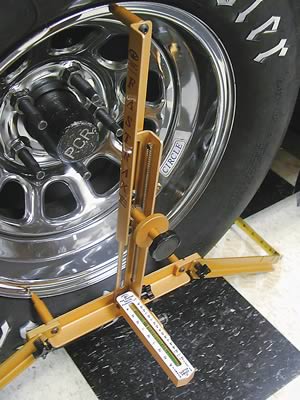
When Jay at Vintage in Wallingford bought his alignment rack, I had my Daytona Coupe aligned there. I then tested the calibration of my equipment and it was spot on. Not bad for $150.
When Jay at Vintage in Wallingford bought his alignment rack, I had my Daytona Coupe aligned there. I then tested the calibration of my equipment and it was spot on. Not bad for $150.


3rd Gear Member
Joined: Aug 2006
Posts: 886
From: North East Texas on the Red River
I've followed this thread and feel I should add my 2 cents. You can make your own equipment, buy some relatively inexpensive tools, or go to an alignment shop and end up with a great alignment or a total mess. Personally, I've used this tool for many alignments at home and it works great and is very accurate:
When Jay at Vintage in Wallingford bought his alignment rack, I had my Daytona Coupe aligned there. I then tested the calibration of my equipment and it was spot on. Not bad for $150.
When Jay at Vintage in Wallingford bought his alignment rack, I had my Daytona Coupe aligned there. I then tested the calibration of my equipment and it was spot on. Not bad for $150.
This is turning into a great thread.
So fakesnakes, where did you get this tool? It looks worth the money.
Coupester,
Thanks for the explanation of your apparati. I have been wanting to build some sort of poormans alignment jig or two for years, but I get by with an old camber gauge and a tape measure when the need arises, and then I forget about it until the need pops up again.
Maybe you guys are inspiring me.
4th Gear Member
Joined: Sep 2008
Posts: 1,839
From: Connecticut
Most places that carry race equipment carry Fastrax, but I find Summit Racing one of the best:
http://store.summitracing.com/egnsea...se&Ntt=fastrax
http://store.summitracing.com/egnsea...se&Ntt=fastrax
3rd Gear Member
Joined: Aug 2006
Posts: 886
From: North East Texas on the Red River
Thanks guys for the info and the link.
Upon looking at the FastTrax and the toe attachment, I found that the idea was to measure from the slot in the Fast Trax adapter arm to a point on the other side being a scribe line, a board across the sidewall(bad plan!) or to a point on the tread.
It seems to me that in order to use this properly for adjusting toe, you would need one of these on each wheel in order to get a true measurement.
The FastTrax looks like a great device for measuring caster/camber although my current gauge works good, but I like Coupesters home made gadget better for doing toe.
Thanks again.
Upon looking at the FastTrax and the toe attachment, I found that the idea was to measure from the slot in the Fast Trax adapter arm to a point on the other side being a scribe line, a board across the sidewall(bad plan!) or to a point on the tread.
It seems to me that in order to use this properly for adjusting toe, you would need one of these on each wheel in order to get a true measurement.
The FastTrax looks like a great device for measuring caster/camber although my current gauge works good, but I like Coupesters home made gadget better for doing toe.
Thanks again.

Thread
Thread Starter
Forum
Replies
Last Post
