


camber bolt questions , help please


Thread Starter
2nd Gear Member
Joined: Mar 2011
Posts: 217
From: CA
 camber bolt questions , help please
got an alignment today, after hitting a piece of wood on the street the other day. 
wasn't too bad but felt off a bit.
got the firestone lifetime adjutment of course.
all went well but the right camber reading is a bit beyond the specs (-1.5 - 0 degr), its -1.8 degr. fyi, left side is -1.0.
now, i don't think its much of an issue yet (correct me if i'm wrong!) but it made mee look into my options, not lowered i think camber bolts are the next step if needed.
then i got different pieces of information from firestone, ford, various threads and the internets.
ford instructions asking for camberbolts in the LOWER bolt hole and ENLARGING hole w GRINDING tool, thats also what the automated print from firestone spit out, i assume based underlaying ford information.
i found numerous stuff about eibach bolts but could not find actual install instructions, but it appears they are meant to go into the UPPER bolt hole WITH or WITHOUT grinding.
firestone uses "specialty products" camber bolts, their website actually had good install instructions and (general, not mustang specific) video. also put the bolt into UPPER hole, no GRINDIND.
i guess my questions to anyone w according knowledge/experience are:
- LOWER or UPPER holes? does it matter or not? is it maybe bolt manufacturer specific?
- GRINDING holes yes or no? is it maybe bolt manufacturer specific?
- why would ford ask for LOWER holes, others for UPPER?
car drives/feels well right now so i don't think i need to rush or do anything yet but i want to be prepared when the need or desire surfaces.
i'd appreciate all input.
wasn't too bad but felt off a bit.
got the firestone lifetime adjutment of course.
all went well but the right camber reading is a bit beyond the specs (-1.5 - 0 degr), its -1.8 degr. fyi, left side is -1.0.
now, i don't think its much of an issue yet (correct me if i'm wrong!) but it made mee look into my options, not lowered i think camber bolts are the next step if needed.
then i got different pieces of information from firestone, ford, various threads and the internets.
ford instructions asking for camberbolts in the LOWER bolt hole and ENLARGING hole w GRINDING tool, thats also what the automated print from firestone spit out, i assume based underlaying ford information.
i found numerous stuff about eibach bolts but could not find actual install instructions, but it appears they are meant to go into the UPPER bolt hole WITH or WITHOUT grinding.
firestone uses "specialty products" camber bolts, their website actually had good install instructions and (general, not mustang specific) video. also put the bolt into UPPER hole, no GRINDIND.
i guess my questions to anyone w according knowledge/experience are:
- LOWER or UPPER holes? does it matter or not? is it maybe bolt manufacturer specific?
- GRINDING holes yes or no? is it maybe bolt manufacturer specific?
- why would ford ask for LOWER holes, others for UPPER?
car drives/feels well right now so i don't think i need to rush or do anything yet but i want to be prepared when the need or desire surfaces.
i'd appreciate all input.

2nd Gear Member
Joined: Jun 2011
Posts: 486
From: Texas

Either way works. It's the net result that matters.
Grinding the holes in the strut allows a full diameter bolt. The Eiback bolts are undersized with a cam lobe that is used to push the spindle in and out.
I've heard some say they aren't as strong, but they did do the engineering on them.
Grinding the holes in the strut allows a full diameter bolt. The Eiback bolts are undersized with a cam lobe that is used to push the spindle in and out.
I've heard some say they aren't as strong, but they did do the engineering on them.

6th Gear Member
Joined: Feb 2007
Posts: 7,635
From: state of confusion
Whether the upper or the lower hole is used will have a slightly different effect on toe, and there may be greater strength margins at the lower holes.
The reason for using the (Ford) full-size bolts in oversize holes is because that is a Ford-approved method of camber correction. It's the method the dealership is supposed to follow if you brought the car to them at any time and for any reason - even if it was a brand-new car that slipped through Ford QC with out-of-spec camber (and trust me, that does happen at least occasionally ). There is no guarantee that any other method would actually pass Ford's standards.
As far as I know, none of the aftermarket bolts can be torqued down to the full torque spec for the normal strut to knuckle bolts, so the joint can't ever be as tight as it is supposed to be for unrestricted use of the car, nor will it still have the OE safety margins that cover you for the effects of metal fatigue over the long run.
You have one of the "early" model year S197 Mustangs. Ford has upgraded the OE strut to knuckle bolts and the knuckles themselves since then, and for a very good reason. So I'm a lot uneasy about going with any repair that's weaker or less rigid than early S197 OE.
Something is either bent or has shifted, in which case your toe will also be off. Bad toe is harder on tires than bad camber, so I wouldn't put this off too long.
Norm
The reason for using the (Ford) full-size bolts in oversize holes is because that is a Ford-approved method of camber correction. It's the method the dealership is supposed to follow if you brought the car to them at any time and for any reason - even if it was a brand-new car that slipped through Ford QC with out-of-spec camber (and trust me, that does happen at least occasionally
). There is no guarantee that any other method would actually pass Ford's standards.As far as I know, none of the aftermarket bolts can be torqued down to the full torque spec for the normal strut to knuckle bolts, so the joint can't ever be as tight as it is supposed to be for unrestricted use of the car, nor will it still have the OE safety margins that cover you for the effects of metal fatigue over the long run.
You have one of the "early" model year S197 Mustangs. Ford has upgraded the OE strut to knuckle bolts and the knuckles themselves since then, and for a very good reason. So I'm a lot uneasy about going with any repair that's weaker or less rigid than early S197 OE.
Something is either bent or has shifted, in which case your toe will also be off. Bad toe is harder on tires than bad camber, so I wouldn't put this off too long.
Norm
Thread Starter
2nd Gear Member
Joined: Mar 2011
Posts: 217
From: CA
Whether the upper or the lower hole is used will have a slightly different effect on toe, and there may be greater strength margins at the lower holes.
The reason for using the (Ford) full-size bolts in oversize holes is because that is a Ford-approved method of camber correction. It's the method the dealership is supposed to follow if you brought the car to them at any time and for any reason - even if it was a brand-new car that slipped through Ford QC with out-of-spec camber (and trust me, that does happen at least occasionally ). There is no guarantee that any other method would actually pass Ford's standards.
As far as I know, none of the aftermarket bolts can be torqued down to the full torque spec for the normal strut to knuckle bolts, so the joint can't ever be as tight as it is supposed to be for unrestricted use of the car, nor will it still have the OE safety margins that cover you for the effects of metal fatigue over the long run.
You have one of the "early" model year S197 Mustangs. Ford has upgraded the OE strut to knuckle bolts and the knuckles themselves since then, and for a very good reason. So I'm a lot uneasy about going with any repair that's weaker or less rigid than early S197 OE.
Something is either bent or has shifted, in which case your toe will also be off. Bad toe is harder on tires than bad camber, so I wouldn't put this off too long.
Norm
The reason for using the (Ford) full-size bolts in oversize holes is because that is a Ford-approved method of camber correction. It's the method the dealership is supposed to follow if you brought the car to them at any time and for any reason - even if it was a brand-new car that slipped through Ford QC with out-of-spec camber (and trust me, that does happen at least occasionally
). There is no guarantee that any other method would actually pass Ford's standards.As far as I know, none of the aftermarket bolts can be torqued down to the full torque spec for the normal strut to knuckle bolts, so the joint can't ever be as tight as it is supposed to be for unrestricted use of the car, nor will it still have the OE safety margins that cover you for the effects of metal fatigue over the long run.
You have one of the "early" model year S197 Mustangs. Ford has upgraded the OE strut to knuckle bolts and the knuckles themselves since then, and for a very good reason. So I'm a lot uneasy about going with any repair that's weaker or less rigid than early S197 OE.
Something is either bent or has shifted, in which case your toe will also be off. Bad toe is harder on tires than bad camber, so I wouldn't put this off too long.
Norm
thanks norm,
that makes sense, different dia resulting in grinding or not, different torque specs, different outcome regarding overall structural strength. things to take into account, for a regular dd i assume the smaller dia screws would be sufficient?! its apparently a widely used solution (eibach, specialty prod).
any chance you know the different (ford vs eibach etc) dia's?
any chance you have the part# for the ford ones?
lower bolt hole more strength. i guess one could use the either camber bolt(s) in the lower hole?
i also figured that the toe will be more of an issue. they got it to 0.03 degr left, 0.13 right, 0.16 degr total, feels ok to me.
6th Gear Member
Joined: Feb 2007
Posts: 7,635
From: state of confusion
They are widely used because they're a cheap fix for a bad camber situation. The average car owner has no concept of what else is going on in a joint that uses a bolt of some sort and a nut that fits onto it to hold everything together, so all he sees is not having to spend much $.
Sure, there's some level of use below which they probably are "good enough". But since "regular DD" driving can vary more widely than you think, trying to define acceptability in that manner really isn't good enough. For instance (and I'm not making any of this up), earlier this year I replaced a radiator in a co-worker's 4-cylinder automatic tranny Camry. He's 75 years old (I think he works part time just for something to keep mentally active with). I strongly doubt that your regular daily driving in a Mustang is anywhere near as mild or as easy on the suspension as his is in that Toyota.
BTW, I'm guessing that your steering wheel is just a hair off to the right of being in the same position as it was before.
Norm
Sure, there's some level of use below which they probably are "good enough". But since "regular DD" driving can vary more widely than you think, trying to define acceptability in that manner really isn't good enough. For instance (and I'm not making any of this up), earlier this year I replaced a radiator in a co-worker's 4-cylinder automatic tranny Camry. He's 75 years old (I think he works part time just for something to keep mentally active with). I strongly doubt that your regular daily driving in a Mustang is anywhere near as mild or as easy on the suspension as his is in that Toyota.
BTW, I'm guessing that your steering wheel is just a hair off to the right of being in the same position as it was before.
Norm
Last edited by Norm Peterson; Aug 29, 2011 at 12:05 PM.

4th Gear Member
Joined: Dec 2007
Posts: 1,692
From: Ontario, Canada
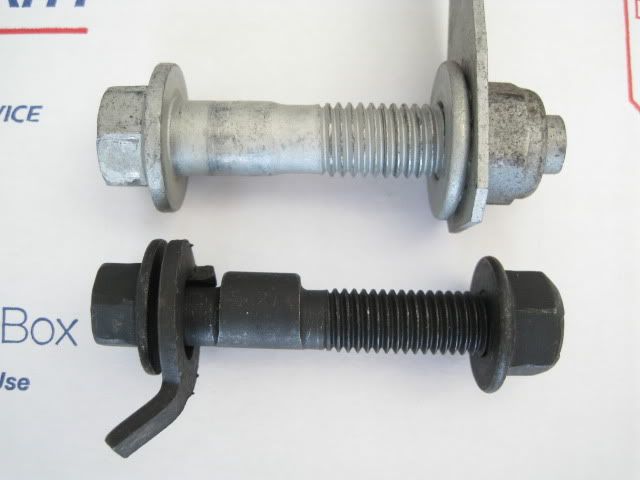
A good indication of the importance of this is the early Ford course thread bolts got torqued to 148 ft lb. The later fine thread bolts get torqued to 166 ft lb. They made that change and others for a reason and it wasn't to save money.
Now look at the torque spec on the Eibach bolts.
You may not be tracking your car 10 days a year on 285 wide R compound tires but if you are more than a little old lady who only drives to church on Sunday then carefully consider the cost benefit of cheaping out on a critical component.
Now look at the torque spec on the Eibach bolts.
You may not be tracking your car 10 days a year on 285 wide R compound tires but if you are more than a little old lady who only drives to church on Sunday then carefully consider the cost benefit of cheaping out on a critical component.
Thread Starter
2nd Gear Member
Joined: Mar 2011
Posts: 217
From: CA
thanks guys for clearing all that up for me in such short time.
i think i get around with the current camber settings for a while but once it has to be done i will go for the oem ford bolts in the lower clamp holes.
i did figured out the part# for the kit = 4R3Z3B236AB, anyone bought this? does it come w any instructions? if so can you post a scan/link?
i think i get around with the current camber settings for a while but once it has to be done i will go for the oem ford bolts in the lower clamp holes.
i did figured out the part# for the kit = 4R3Z3B236AB, anyone bought this? does it come w any instructions? if so can you post a scan/link?

2nd Gear Member
Joined: Nov 2010
Posts: 244
From: BC
I wouldn't ever advise anyone to go with a non-Ford solution on this, but I have H&R camber bolts in the front of my car. I put them in the upper hole, set the camber and then torqued them to the full 166 ft-lbs.
I did it this way because the H&R bolts are 14mm, fine thread, and the eccentric relief is radiused where it merges into the full diameter sections. The bolts actually look like forgings although they aren't advertised as such. The eccentric relief only eats about .075 into the diameter on one side of the bolt and only in the non-threaded part. Basically, it's like the stock bolt with a small relief ground into it, and most of the bolt is still there. My reading up on thread dimensions indicates that the H&R bolts have as much cross-section metal in the eccentric sections as the threaded section of the stock bolt. The H&R's give you less adjustment range, but they're much stronger than whatever is in the picture above.
I did it this way because the H&R bolts are 14mm, fine thread, and the eccentric relief is radiused where it merges into the full diameter sections. The bolts actually look like forgings although they aren't advertised as such. The eccentric relief only eats about .075 into the diameter on one side of the bolt and only in the non-threaded part. Basically, it's like the stock bolt with a small relief ground into it, and most of the bolt is still there. My reading up on thread dimensions indicates that the H&R bolts have as much cross-section metal in the eccentric sections as the threaded section of the stock bolt. The H&R's give you less adjustment range, but they're much stronger than whatever is in the picture above.
Last edited by JAJ; Aug 30, 2011 at 12:49 PM.

Thread
Thread Starter
Forum
Replies
Last Post
