


Vacuum Advance


Thread Starter
5th Gear Member
Joined: Apr 2007
Posts: 2,100
From: Texas Hill Country
 Vacuum Advance
I was having some issues with consistency with my MSD mechanical advance distributor, so I took it out and put in a vacuum advance version to see what it could do for me. For any of you who might know, what is the vacuum advance curve like on the MSD distributors? This is the Pro Billet 351W version. All the instructions say is up to 10 degrees above 15" vacuum and to hook it to your ported vacuum source. I know ported vacuum is basically 0 at idle. How does it compare to manifold vacuum? Lets say I am running 10" manifold vacuum at idle and 18-20" of manifold vacuum under light cruise. What will the ported vacuum be at light cruise? Will it be 18-20" as well? I guess I can hook up a gauge, but thought I would ask y'all first.

6th Gear Member
Joined: May 2009
Posts: 5,232
From: PA
I was having some issues with consistency with my MSD mechanical advance distributor, so I took it out and put in a vacuum advance version to see what it could do for me. For any of you who might know, what is the vacuum advance curve like on the MSD distributors? This is the Pro Billet 351W version. All the instructions say is up to 10 degrees above 15" vacuum and to hook it to your ported vacuum source. I know ported vacuum is basically 0 at idle. How does it compare to manifold vacuum? Lets say I am running 10" manifold vacuum at idle and 18-20" of manifold vacuum under light cruise. What will the ported vacuum be at light cruise? Will it be 18-20" as well? I guess I can hook up a gauge, but thought I would ask y'all first.
At light cruise, the ported vacuum will likely be about zero.
If the curve, not just max limit, of the MSD is not fully adjustable, don't use it. You'd be better off with a stock distributor. Of course, it probably is.
The vacuum should advance a certain amount for each inch of vacuum.

6th Gear Member
Joined: Oct 2006
Posts: 6,417
From: Cork, Ireland
ported and manifold vacuum are the same, only at idle the ported is 0 and manifold high.
obviously at wot both are 0 if all is good, at idle with the plate closed it's high manifold and 0 ported. as soon as you open for a bit they'll move to each other and already at partial open they should be the same. i wouldn't be surprised if you have 18 at light cruise as well ported. here's a fella who made a chart driving, and from that it seems at 10%+ throttle they are the same
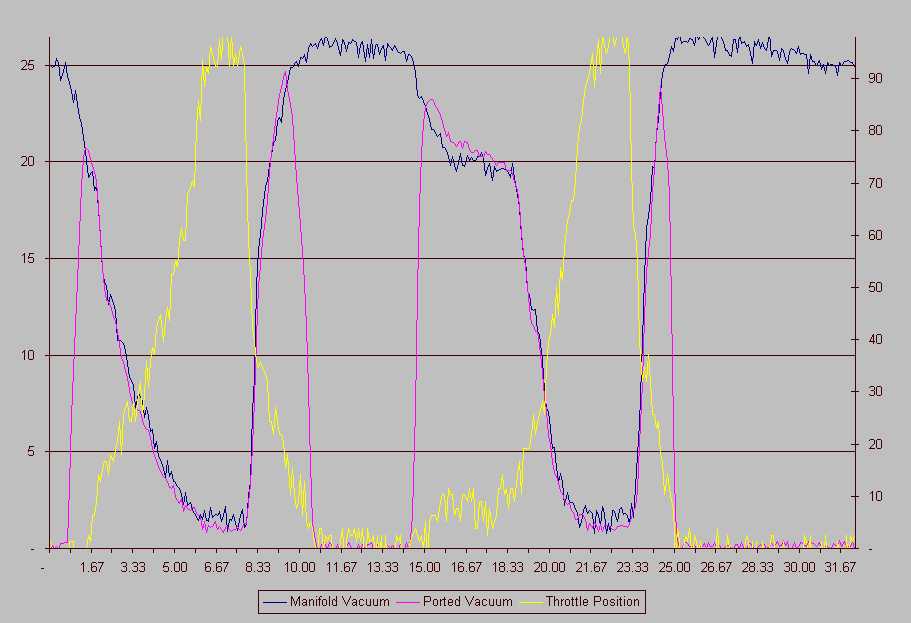
has a nice read as well:
http://www.gofastforless.com/ignition/advance.htm
kalli
obviously at wot both are 0 if all is good, at idle with the plate closed it's high manifold and 0 ported. as soon as you open for a bit they'll move to each other and already at partial open they should be the same. i wouldn't be surprised if you have 18 at light cruise as well ported. here's a fella who made a chart driving, and from that it seems at 10%+ throttle they are the same
has a nice read as well:
http://www.gofastforless.com/ignition/advance.htm
kalli
6th Gear Member
Joined: Oct 2006
Posts: 6,417
From: Cork, Ireland
and 10 degrees might be a decent max value. from what you write it sounds like 10 max for anything above 15". i remember reading the charts that 2+2 posted for centrifugal and vac advance. they specified 10 max as well
Thread Starter
5th Gear Member
Joined: Apr 2007
Posts: 2,100
From: Texas Hill Country
So from what you are saying, at 0" the vacuum advance is 0. For 15"+ vacuum, the vacuum advance is 10 degrees. For anything in between it is incremental? Is it a linear relationship (i.e. .66degrees of vacuum per inch of vacuum)?
Right now, I am running 15degrees of initial timing with 36degrees of total advance (21 degrees mechanical). I am going to bump this up a degree or two as I am still not getting detonation at WOT, but I am curious as to what the timing is doing during part throttle. It does not take much for my engine to drop below 15" of manifold vacuum but I have no idea what is going on with the ported vacuum. Having vacuum advance may be pointless, on this engine, but I thought I would give it a try to see if it helped with the highway cruising mpg and power.
Right now, I am running 15degrees of initial timing with 36degrees of total advance (21 degrees mechanical). I am going to bump this up a degree or two as I am still not getting detonation at WOT, but I am curious as to what the timing is doing during part throttle. It does not take much for my engine to drop below 15" of manifold vacuum but I have no idea what is going on with the ported vacuum. Having vacuum advance may be pointless, on this engine, but I thought I would give it a try to see if it helped with the highway cruising mpg and power.
6th Gear Member
Joined: Oct 2006
Posts: 6,417
From: Cork, Ireland
from what i know the relationship is linear as it's vacuum against spring so to say. at WOT you don't have to worry about vacuum advance as it's not advancing anything. the reason vac advance is used is that on part throttle you have less cylinder fill and therefore you need to ignite earlier. i usually have my vac advance connected to manifold vacuum. Mine is adjustable and I know when it's too much when I have the car jerking at slow speeds. when it feels like someone driving a moped for the first time. but no matter where you hook it up, you have too much vac advance if it pings in part throttle cruise or accelleration. well at least that's my opinion to all this :-)
on your note the vac advance being pointless, i believe it's rather stupid to not run a vac advance on a street driven engine. the reason they are sold without vac advance is only for racing, and that is when your foot only knows two poitions: on and off. WOT is hardly ever happening when driving on street. at least that's why i believe you and i are not driving a cinquecento ... ;-)
on your note the vac advance being pointless, i believe it's rather stupid to not run a vac advance on a street driven engine. the reason they are sold without vac advance is only for racing, and that is when your foot only knows two poitions: on and off. WOT is hardly ever happening when driving on street. at least that's why i believe you and i are not driving a cinquecento ... ;-)
Last edited by kalli; May 10, 2010 at 04:27 PM.
Thread Starter
5th Gear Member
Joined: Apr 2007
Posts: 2,100
From: Texas Hill Country
I will switch it over to manifold vacuum since I know what it is doing. I am not sure if my idle timing will be too high then or not. I may have to switch over to a larger mechanical timing stop to keep my 36-37* total timing and drop my initial non-vacuum advance timing down some. Idle timing on my engine will probably be about 22* with the dizzy plugged into the manifold vacuum port under the current configuration...assuming the vacuum advance is linear.
Thread Starter
5th Gear Member
Joined: Apr 2007
Posts: 2,100
From: Texas Hill Country
I switched over to manifold vacuum on the 50 miles home this afternoon while having my vacuum gauge hooked to the ported vacuum to see what it was doing under different driving conditions.
What I notice from having the timing hooked up to the manifold vacuum was snappier throttle. I never heard pinging, even at WOT, so I probably have a few more degrees I can add. I did spend the first 10minutes in bumper to bumper traffic and noticed a different smell. I cannot blame it on the timing switch, but I wonder if 22-24*(initial + vacuum hooked to manifold) of timing at idle would cause a different smell...I wonder how much timing at idle and low rpm is too much. I never heard pinging and the starter fired the hotrod right up, so the 15-16* of initial is not too much for it. I saw no AFR change but maybe a little more power while in partial throttle. I also saw about 150rpm at idle, which sort of surprised me. Next, I will get a T fitting and see what the vacuum at idle is doing with the increased timing from being hooked to the manifold vacuum.
The vacuum gauge hooked to ported vacuum was interesting. It was 0 at closed throttle such as at idle or when decelerating. It went to 10" almost immediately upon hitting the throttle and while cruising under normal conditions it was 15-17" which is about what manifold vacuum is during that time.
My conclusion is if hooked to ported vacuum, the dizzy is not going to run high timing during deceleration, idle, or very light throttle. With manifold vacuum, it will. Other than that, they will be very similar from partial throttle to WOT. I just wonder if I am putting too much timing to it during put-put times in traffic??? I also wonder what that different smell was. I did not notice it after my drive, so it could have been a fluke. I will keep a nose out for it on my next trip.
What I notice from having the timing hooked up to the manifold vacuum was snappier throttle. I never heard pinging, even at WOT, so I probably have a few more degrees I can add. I did spend the first 10minutes in bumper to bumper traffic and noticed a different smell. I cannot blame it on the timing switch, but I wonder if 22-24*(initial + vacuum hooked to manifold) of timing at idle would cause a different smell...I wonder how much timing at idle and low rpm is too much. I never heard pinging and the starter fired the hotrod right up, so the 15-16* of initial is not too much for it. I saw no AFR change but maybe a little more power while in partial throttle. I also saw about 150rpm at idle, which sort of surprised me. Next, I will get a T fitting and see what the vacuum at idle is doing with the increased timing from being hooked to the manifold vacuum.
The vacuum gauge hooked to ported vacuum was interesting. It was 0 at closed throttle such as at idle or when decelerating. It went to 10" almost immediately upon hitting the throttle and while cruising under normal conditions it was 15-17" which is about what manifold vacuum is during that time.
My conclusion is if hooked to ported vacuum, the dizzy is not going to run high timing during deceleration, idle, or very light throttle. With manifold vacuum, it will. Other than that, they will be very similar from partial throttle to WOT. I just wonder if I am putting too much timing to it during put-put times in traffic??? I also wonder what that different smell was. I did not notice it after my drive, so it could have been a fluke. I will keep a nose out for it on my next trip.
6th Gear Member
Joined: Oct 2006
Posts: 6,417
From: Cork, Ireland
your conclusion absolutely correct from the way I understand it as well. I find as well that it's driving a bit more snappier. the 150rpm idle increaser is no surprise. would have expected even a bit more, but it's probably because i have nearly 15" vacuum at idle. does help with massive cams to further close the throttle plate if you need to. my setup is about borderline, however me and my car feel a bit happier with manifold vacuum.
you sure you cannot adjust that MSD vac advance? usually with an allen key that you stick into the hole where the vac hose attaches to (allen key is usually provided). you could play around with that then.
Since you know what pinging sounds like, I'd say you're good if you don't hear any. can always check the plugs for pepper.
Kalli
you sure you cannot adjust that MSD vac advance? usually with an allen key that you stick into the hole where the vac hose attaches to (allen key is usually provided). you could play around with that then.
Since you know what pinging sounds like, I'd say you're good if you don't hear any. can always check the plugs for pepper.
Kalli

Thread
Thread Starter
Forum
Replies
Last Post
TfcCDR
V6 (1994-2004) Mustangs
1
Sep 14, 2015 12:08 PM
